
What Is a Plasma Tube Cutting Machine?
A plasma tube cutting machine (also called a CNC plasma pipe cutter or square tube plasma cutting machine) uses an electrically ionized gas arc to cut conductive metal tubing and pipe.
The plasma arc melts the material while high-velocity gas removes molten metal from the cut path.
Modern CNC plasma tube cutting machines commonly use rotary chucks and automated positioning systems to process round tube, square tube, pipe, and structural profiles.
Typical materials include:
-
carbon steel
-
stainless steel
-
aluminum
-
alloy steel
-
copper
-
aluminum
-
titanium
-
galvanized steel
Plasma tube cutting systems are commonly used in:
-
structural steel fabrication
-
agricultural equipment manufacturing
-
construction equipment
-
general metal fabrication
-
heavy-duty industrial fabrication
Common Advantages of Plasma Tube Cutting Machines
-
Lower initial equipment cost
-
Capable of processing thick conductive materials
-
Widely used in general fabrication environments
-
Proven technology with broad industry adoption
Common Limitations of Plasma Tube Cutting Machines
-
Rougher cut edges that often require grinding
-
Wider heat-affected zone
-
Lower dimensional accuracy
-
Higher consumable wear
-
More limited automation capability
-
Reduced efficiency for complex geometries and high-precision production
What Is a Laser Tube Cutting Machine?
A laser tube cutting machine uses a concentrated fiber laser beam to cut metal tubing, pipe, and structural profiles with high precision.
Unlike plasma cutting, the laser process is non-contact. The focused beam melts and vaporizes material cleanly while CNC motion systems precisely control cutting position and geometry.
Modern fiber laser tube cutting machines are capable of processing:
-
round tube
-
square tube
-
rectangular tube
-
angle iron
-
channel
-
H-beam
-
I-beam
-
custom structural profiles
Fiber laser tube cutting systems are widely used in:
-
automotive manufacturing
-
aerospace
-
fitness equipment
-
furniture manufacturing
-
transportation equipment
-
agricultural equipment
-
architectural metal fabrication
-
industrial machinery production
Common Advantages of Fiber Laser Tube Cutting Machines
-
Extremely high precision and repeatability
-
Smooth, burr-free edge quality
-
Reduced grinding and secondary processing
-
Supports advanced automation
-
Capable of intricate geometry and bevel cutting
-
Handles steel, stainless, aluminum, brass, and copper
-
Lower long-term manufacturing labor requirements
Modern High-Power Fiber Laser Capability
Modern high-power fiber laser tube cutting machines are no longer limited to thin materials.
Systems in the 6 kW–60 kW range are now commonly used for:
-
heavy-wall tube cutting
-
structural steel fabrication
-
large-diameter pipe processing
-
automated production lines
-
high-volume industrial manufacturing
High-power laser tube cutting systems can process many thick-wall applications while maintaining tighter tolerances, cleaner edges, and greater automation capability than traditional plasma systems.
Plasma vs Laser Tube Cutting — Key Differences
Both plasma and laser technologies can process metal tubing and pipe effectively, but they differ significantly in cut quality, automation capability, labor requirements, and production efficiency.
Plasma cutting remains common in general fabrication environments processing thick conductive materials.
However, modern fiber laser tube cutting machines are increasingly replacing plasma systems because they provide:
-
higher precision
-
cleaner edges
-
reduced secondary processing
-
improved production consistency
-
advanced automation
-
faster changeovers
-
more efficient downstream assembly
Key Factor |
Plasma Tube Cutter |
Fiber Laser Tube Cutter |
|---|---|---|
Cutting Accuracy |
Moderate |
High precision |
|
Edge Quality |
Rougher edges; grinding often required |
Smooth, weld-ready edges |
|
Secondary Processing |
Frequent grinding/deburring |
Minimal secondary processing |
|
Material Thickness |
Good for thick conductive materials |
Handles thin to heavy-wall tube depending on laser power |
|
Material Flexibility |
Conductive metals only |
Steel, stainless, aluminum, brass, copper |
|
Heat-Affected Zone |
Larger |
Smaller |
|
Automation Capability |
Limited |
Advanced automation available |
|
Complex Geometry |
Limited |
Excellent for intricate cuts and bevels |
|
Production Consistency |
Varies with consumable wear |
Highly repeatable |
|
Labor Requirements |
Higher manual involvement |
Reduced manual labor |
|
Operating Efficiency |
Lower overall workflow efficiency |
Higher manufacturing integration |
|
Upfront Cost |
Lower |
Higher |
|
Long-Term Manufacturing ROI |
Moderate |
Often higher in production environments |
Plasma systems may maintain advantages in some extremely thick material applications where edge quality and precise cuts are less critical.
However, many manufacturers still choose high-power fiber laser systems because they reduce labor, improve throughput, minimize rework, and consolidate multiple fabrication processes into a single automated operation.
Why Manufacturers Are Replacing CNC Plasma Tube Cutting Machines
Many fabrication shops originally adopted plasma tube cutting machines because of their lower purchase price and ability to process thick conductive materials.
However, manufacturing requirements have changed significantly.
Today's production environments increasingly require:
-
tighter tolerances
-
weld-ready edges
-
lower labor dependency
-
automated material handling
-
CAD/CAM integration
-
traceability
-
faster setup changes
-
higher production consistency
-
reduced secondary operations
Fiber laser tube cutting machines address these requirements while improving overall production flow.
Many manufacturers replace plasma systems because laser tube cutting can combine the following processes into a single automated operation:
-
cutting
-
slotting
-
hole creation
-
beveling
-
coping
-
engraving
-
complex geometry processing
This reduces:
-
grinding
-
drilling
-
layout work
-
material handling
-
rework
-
assembly fitment issues
For manufacturers producing high volumes, mixed materials, or complex assemblies, fiber laser tube cutting systems often improve total production efficiency across the entire fabrication workflow.
Plasma vs Laser Operating Costs
Plasma tube cutting machines generally have a lower upfront purchase price than fiber laser tube cutting machines.
For smaller fabrication shops or lower-volume operations, plasma may appear more cost-effective initially.
However, long-term manufacturing cost depends on more than machine price alone.
Manufacturers must also consider:
-
consumable replacement
-
grinding and deburring labor
-
scrap rates and material costs
-
downtime
-
operator involvement
-
material handling
-
downstream assembly efficiency
-
secondary drilling or machining
-
production throughput
Plasma systems rely heavily on consumables such as electrodes and nozzles that wear over time and affect cut consistency.
Fiber laser tube cutting machines reduce many of these costs by producing cleaner and more accurate parts directly from the machine.
Modern laser tube cutting systems also support:
-
automated loading and unloading
-
lights-out production
-
nesting optimization
-
advanced CAD/CAM integration
-
rapid job changeovers
-
integrated bevel cutting
In high-throughput manufacturing environments, total cost per finished part is often lower with a fiber laser tube cutting system despite the higher initial investment.
Explore EMP Fiber Tube Laser Cutting Machines
EMP tube laser cutting machines are rigorously tested, vetted, and selected for unmatched precision, efficiency, and economical operation. Our CNC-operated fiber tube lasers cut steel, stainless, aluminum tubing, and more — delivering clean, accurate results for every application.
| Model |
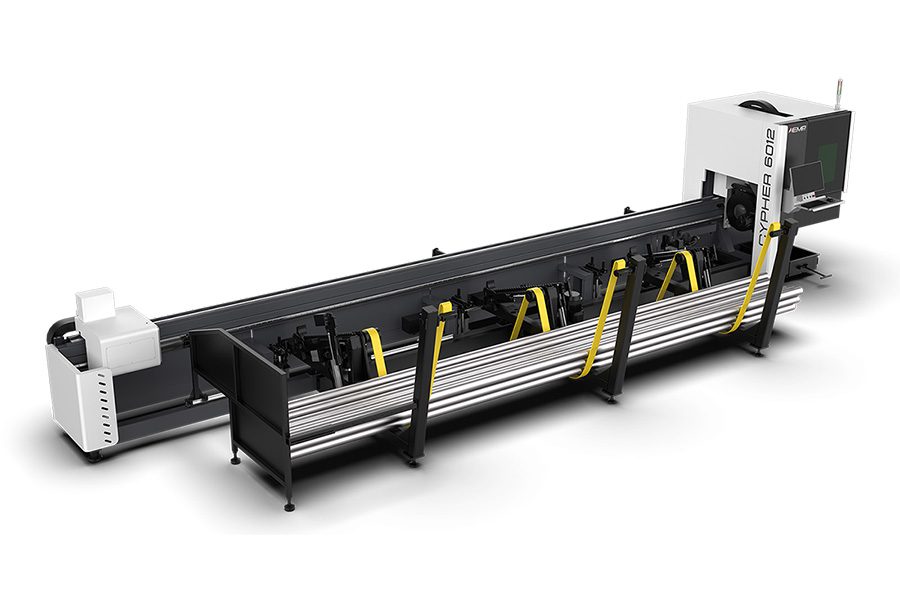
Cypher |
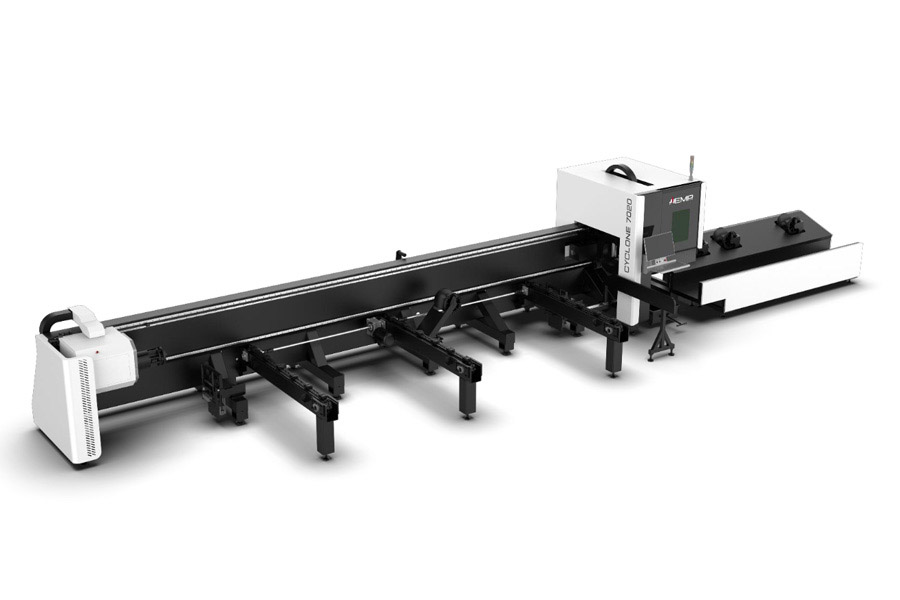
Cyclone |
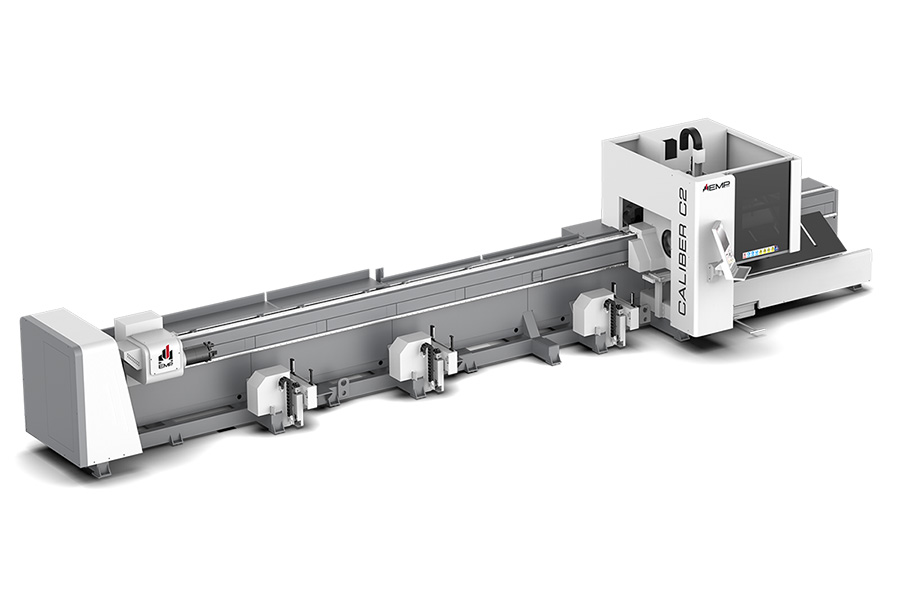
Caliber C2 |
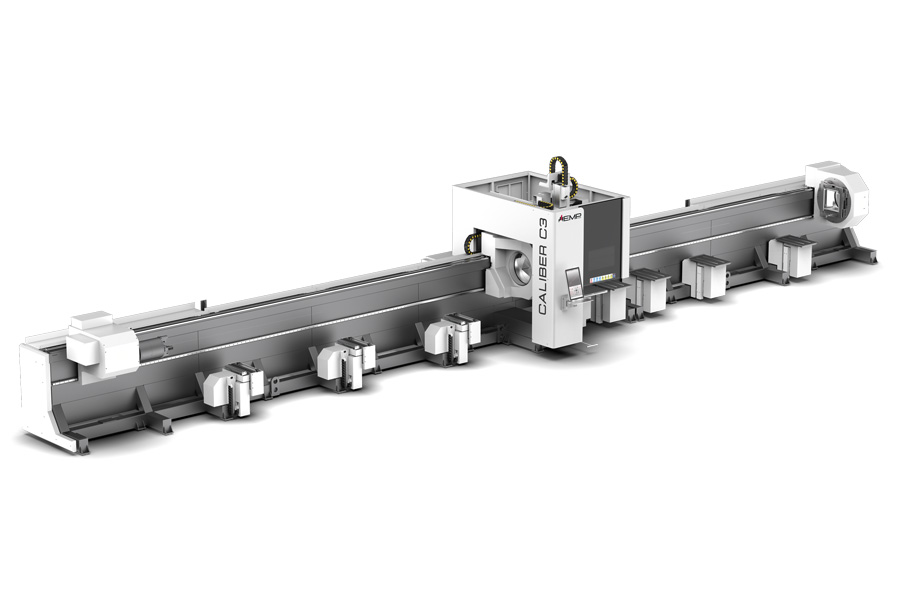
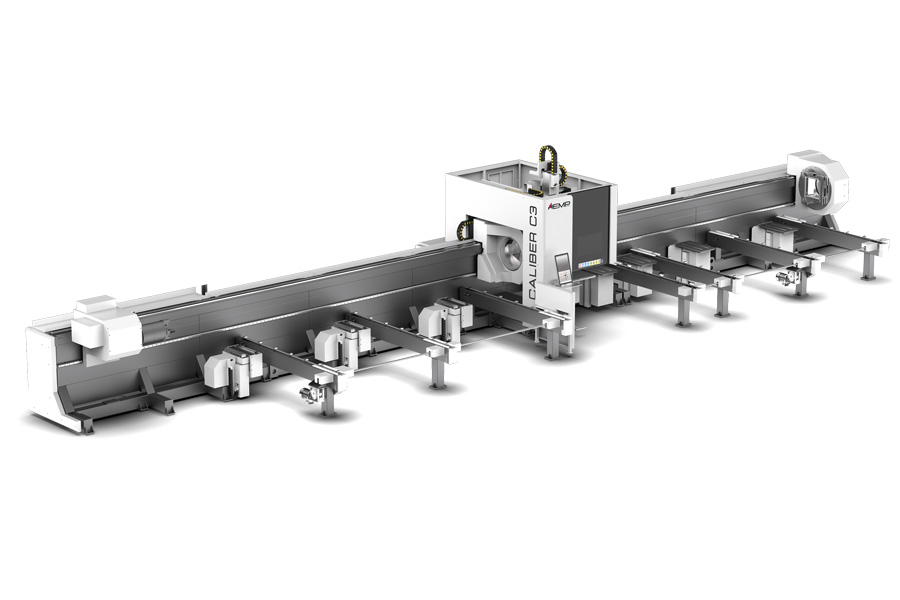
Caliber C3・C4 |
|---|---|---|---|---|
|
Type |
High-Speed Fiber Laser Tube Cutter |
High-Speed Heavy Duty Fiber Laser Tube Cutter |
2-Chuck Heavy Duty Fiber Laser Tube Cutter |
3-Chuck or 4-Chuck Heavy Duty Fiber Laser Tube Cutter |
|
Purpose & Design |
Designed for high-speed production of smaller-diameter tubing with tight tolerances and efficient material handling. |
Built for manufacturers processing larger tube, pipe, and structural profiles with demanding production requirements. |
Heavy-duty side-mounted fiber laser tube cutter engineered for structural fabrication and high-power industrial processing. |
Advanced multi-chuck heavy-duty laser tube cutting systems designed for high-volume automated manufacturing environments. |
|
Laser Power (W) |
1.5kW, 3kW |
1.5kW, 3kW, 6kW, 12kW |
6kW, 12kW, 20kW, 30kW |
6kW, 12kW, 20kW, 30kW, 60kW |
|
Best For |
High-speed small-diameter production |
Heavy-duty pipe & profile processing |
Large structural tube & profile fabrication |
High-volume industrial production |
|
Tube Types |
Round, square, rectangular |
Round, square, structural profiles |
Structural profiles, angle iron, H-beam |
Heavy structural and large-diameter profiles |
|
Tube Capacity |
21' maximun tube length |
24.5' maximun tube length |
Configurable for 22' to 40' maximum tube lengths |
Configurable for 20' to 50' maximum tube lengths |
|
Min Round Tube Diameter |
0.4” (10mm) |
0.6” (15mm) |
0.6” (15mm) |
1.2” (30mm) |
|
Max Round Tube Diameter |
4.72” (120mm) |
9” (230mm) |
9.8” (250mm) |
13.8” (350mm) |
|
Options |
Unloading System, Semi-Automatic and Fully Automatic Feeding Options |
Unloading System, Semi-Automatic and Fully Automatic Feeding Options |
Bevel Laser Head, Flow Drilling/Tapping, Semi-Automatic Loading/Unloading |
Bevel Laser Head, Flow Drilling/Tapping, Semi-Automatic Loading/Unloading |
|
Ideal Production Scale |
Small to medium production |
Medium to high-volume production |
Heavy industrial fabrication |
High-output industrial manufacturing |
|
Starting At |
$123,950 |
$148,950 |
$298,950 |
$368,950 |
|
Learn More |
Built for Production, Backed by Experience
It's easier to enter the world of laser tube cutting with EMP by your side—even for those new to the technology, we provide expert installation, calibration, and training to ensure your machine is fully operational from day one.

Machine sourcing and configuration

Industrial-Grade Reliability and Quality Control

Custom Production Solutions

Professional Installation

USA-based Technical Support and Training

Flexible Support Contracts
Which Tube Cutting Machine Is Right for You?
The right cutting system depends on your production goals, material mix, labor requirements, tolerances, and future growth plans.
When comparing plasma and laser tube cutting machines, manufacturers should evaluate these six key factors:
Key Factor |
Plasma Cutter |
Fiber Laser Cutter |
|---|---|---|
|
1. Material Thickness & Profile Type |
Commonly used for thick conductive materials and basic structural fabrication. |
Capable of processing thin-wall tubing through heavy-wall structural profiles depending on machine power and configuration. High-power fiber laser tube cutting systems can process many applications traditionally associated with plasma while maintaining superior accuracy and edge quality. |
|
2. Cut Quality & Precision |
Moderate tolerances with larger heat-affected zones and additional finishing requirements. |
High repeatability with smooth, weld-ready edges that often eliminate grinding and secondary processing. |
|
3. Production Speed & Throughput |
Effective for general fabrication workflows. |
High-speed cutting, rapid job changeovers, and automated material handling improve overall production throughput. |
|
4. Automation Capability |
Basic CNC functionality with more operator involvement. |
Supports automatic loading/unloading, CAD/CAM integration, nesting optimization, lights-out production, and production tracking. |
|
5. Total Manufacturing Cost |
Lower initial investment but higher consumable usage and labor requirements. |
Higher purchase price but reduced labor, rework, and secondary processing costs over time. |
|
6. Future Scalability |
Suitable for general fabrication and lower-complexity production environments. |
Well suited for manufacturers scaling production, increasing automation, and processing more complex parts and assemblies. |
Quick Decision Guide
Your Priority |
Recommended Technology |
|---|---|
|
Lowest Initial Equipment Cost |
Plasma Tube Cutting |
|
Precision & Weld-Ready Edges |
Fiber Laser Tube Cutting |
|
Reduced Grinding & Secondary Processing |
Fiber Laser Tube Cutting |
|
Advanced Automation & CAD/CAM Integration |
Fiber Laser Tube Cutting |
|
Heavy Structural Fabrication with Basic Tolerances |
Plasma Tube Cutting |
|
Long-Term Production Efficiency |
Fiber Laser Tube Cutting |
|
High-Volume Manufacturing |
Fiber Laser Tube Cutting |
How We Work
From expert planning, delivery and installation to service, training and calibration, EMP Laser provides fast, reliable and professional support.
FAQ
Plasma Cutters vs Laser Cutters
Plasma cutting works with electrically conductive metals including: mild steel, carbon steel, stainless steel, alloy steel, copper, brass, aluminum, titanium, and galvanized steel.
Fiber laser tube cutting machines process all these materials and coated metals while delivering:
-
higher precision
-
cleaner edges
-
reduced heat-affected zones
-
improved repeatability
-
lower secondary processing requirements
Fiber laser systems are widely used when manufacturers require both material flexibility and high production accuracy.
Manufacturers are increasingly replacing plasma systems to improve:
-
precision
-
automation
-
production consistency
-
throughput
-
labor efficiency
Fiber laser tube cutting machines can combine multiple fabrication operations into one automated process while reducing grinding, drilling, deburring, and material handling.
Fiber laser systems produce smoother, burr-free edges that frequently require little or no secondary finishing.
Plasma-cut edges commonly require grinding or cleanup before welding or assembly.
EMP fiber laser systems can achieve repeatable accuracy within ±0.001″ depending on application and material.
Plasma systems generally operate with wider tolerances due to consumable wear and larger heat-affected zones.
For thin- and medium-wall tubing, fiber laser systems often provide substantially faster production throughput with cleaner results and less secondary processing.
Plasma may maintain advantages in some extremely thick material applications.
However, many manufacturers still select laser systems because they improve total workflow efficiency and reduce downstream labor.
Plasma systems generally cost less upfront.
However, manufacturers should also evaluate:
-
consumables
-
labor
-
grinding
-
scrap
-
downtime
-
automation capability
-
rework
-
production throughput
In many high-volume production environments, fiber laser tube cutting systems reduce total manufacturing cost per finished part over time.
Yes.
CNC plasma tube cutting machines support part nesting to improve material utilization and reduce scrap.
Modern fiber laser tube cutting systems also support advanced nesting optimization through integrated CAD/CAM software and automated production workflows.
Because laser systems maintain tighter tolerances and narrower kerf widths, manufacturers can often achieve even greater material efficiency while reducing rework and improving part consistency.
Yes.
Plasma cutting systems are commonly used for thick conductive materials and can process extremely heavy material sections in some industrial applications.
Modern high-power fiber laser tube cutting machines are also capable of processing heavy-wall tube, pipe, and structural profiles across many manufacturing industries.
High-power laser systems in the 12 kW–60 kW range are increasingly used for:
-
structural steel fabrication
-
transportation equipment
-
agricultural equipment manufacturing
-
industrial machinery
-
automated heavy fabrication
Many manufacturers choose fiber laser systems because they provide cleaner edges, tighter tolerances, and greater automation capability while still supporting demanding heavy-wall applications.
Yes.
Many CNC plasma tube cutting machines use rotary axis systems that rotate the tube during cutting to create angled cuts, coping features, and other complex shapes and geometries.
Modern fiber laser tube cutting machines also use advanced multi-axis motion systems capable of more versatile cuts:
-
bevel cutting
-
mitre cutting
-
contour cutting
-
slotting
-
coping
-
intricate 3D geometries
Fiber laser systems are often preferred for complex fabrication because they maintain tighter tolerances and cleaner edge quality across detailed part geometries.
In many manufacturing environments, yes.
Modern fiber laser tube cutting machines are often designed to reduce remnant material and improve overall material utilization compared to traditional plasma tube cutting systems.
Several factors contribute to this:
-
narrower kerf widths
-
tighter positioning accuracy
-
more precise end cuts
-
advanced nesting optimization
-
automated remnant management
-
multi-chuck material handling systems
Many high-end fiber laser tube cutting machines use 3-chuck or 4-chuck designs that allow the machine to grip and reposition material more efficiently during cutting. This helps reduce unusable drop material at the ends of the tube.
Laser systems also produce cleaner and more accurate end cuts, which can improve downstream fit-up and reduce additional trimming or secondary processing.
In high-volume production environments — especially when processing expensive materials or long structural profiles — improved material yield can significantly impact overall manufacturing efficiency and cost per finished part.
Both plasma and fiber laser tube cutting machines require periodic maintenance and replacement components, but the types of wear items and maintenance intervals differ significantly.
Plasma Tube Cutting Systems
Plasma cutting systems rely heavily on consumable components such as:
-
electrodes
-
nozzles
-
shields
-
swirl rings
These components wear continuously during cutting and directly affect:
-
cut quality
-
edge consistency
-
dimensional accuracy
-
pierce performance
In high-production environments, plasma consumables may require frequent inspection and replacement to maintain consistent results.
Fiber Laser Tube Cutting Systems
Fiber laser tube cutting machines also use wear components, including:
-
protective lenses
-
ceramic rings
-
nozzles
-
assist gas components
However, fiber laser systems generally experience less direct cutting-tool wear during normal operation because the cutting process is non-contact.
Modern fiber laser systems are often preferred in automated manufacturing environments because they typically provide:
-
longer maintenance intervals
-
more consistent cut quality over time
-
reduced operator intervention
-
lower secondary processing requirements
Long-Term Manufacturing Considerations
When comparing operating costs, manufacturers should evaluate more than just consumable pricing alone.
Important factors include:
-
replacement frequency and consumable life
-
downtime during maintenance
-
labor required for consumable changes
-
production interruptions
-
cutting applications and cut consistency over long production runs
-
downstream finishing requirements
In many high-volume manufacturing environments, fiber laser tube cutting systems improve overall production efficiency by reducing manual intervention and maintaining more consistent cutting performance over time.
Both plasma and fiber laser cutting systems are widely used industrial technologies that include important safety systems and operator protection requirements.
Plasma cutting eliminates some risks associated with traditional oxy-fuel cutting because it does not rely on flammable fuel gases during the cutting process.
Modern enclosed fiber laser tube cutting machines also provide advanced safety features including:
-
enclosed cutting areas
-
interlocked access systems
-
automated material handling
-
reduced operator exposure
-
integrated fume extraction compatibility
Many manufacturers adopt automated laser systems to reduce manual handling and improve overall production safety and consistency.
The better system depends on production requirements.
Plasma cutting remains common in general fabrication environments focused primarily on lower upfront equipment cost.
Fiber laser cutting is often more preferred by manufacturers requiring:
-
high precision
-
cleaner edges
-
automation
-
reduced secondary processing
-
complex geometries
-
scalable production efficiency
-
less material waste
Fiber laser systems can offer lower operating costs in the long term.
Plasma Cutting
Plasma cutting is a metal fabrication process that uses an intense heat, ionized gas known as plasma, to cut through electrically conductive materials like steel and aluminum.
Plasma cutting operates by generating an electric arc between an electrode and the metal, ionizing gas into plasma at temperatures up to 30,000°F to 40,000°F.
What are some disadvantages of plasma cutting?
Plasma cutting produces:
-
wider kerfs
-
rougher edge quality
-
larger heat-affected zones
Parts often require additional grinding or finishing before assembly or welding.
Plasma systems also rely heavily on consumables that wear over time and affect cut consistency.
Plasma cutting only works with electrically conductive materials.
It cannot process non-conductive materials such as:
-
wood
-
plastic
-
composites
-
glass
Yes.
Plasma cutting is substantially faster than traditional oxy-fuel cutting on many medium- and thick-material applications and is commonly used in fabrication environments that require higher productivity than manual flame cutting methods.
However, modern fiber laser tube cutting machines can further improve production efficiency on many tube and profile applications through:
-
higher cutting speeds on thin- and medium-wall materials
-
automated loading and unloading
-
faster job changeovers
-
reduced secondary processing
-
tighter dimensional accuracy
For manufacturers focused on automated production and reduced downstream labor, fiber laser systems often provide greater overall workflow efficiency than either plasma or oxy-fuel cutting.
Fiber Laser Tube Cutters
Tube cutting capacity depends on machine configuration and chuck size.
Modern tube laser cutting machines can process a wide range of:
-
round tubing
-
square tubing
-
rectangular tubing
-
pipe
-
structural profiles
Heavy-duty laser tube cutting systems are available for both small-diameter precision tubing and large structural profiles used in industrial fabrication.
Advanced multi-chuck systems can also support longer tube lengths, reduced remnant material, and automated material handling for high-volume production environments.
Yes.
Modern high-power fiber laser tube cutting machines are widely used for heavy-wall tube, pipe, and structural profile processing across industrial manufacturing applications.
Systems in the 6 kW–60 kW range are commonly used in:
-
structural fabrication
-
transportation equipment
-
agricultural machinery
-
heavy machinery production
Fiber laser systems often provide better accuracy, cleaner edges, lower rework, and greater automation capability than plasma systems.
Yes.
Modern fiber laser pipe cutting machines can perform:
-
hole cutting
-
slotting
-
beveling
-
coping
-
contour cutting
within a single automated operation, reducing manual methods and additional fabrication steps.
Yes.
Combination sheet-and-tube laser systems can process both flat sheet metal and tube profiles using a shared laser source and cutting head.
Typical ranges include:
-
2–4 kW for lighter tubing and prototype production
-
6–12 kW for heavy production and thicker materials
-
20 kW+ for large structural profiles and heavy-duty industrial fabrication
The correct power level depends on:
-
material thickness
-
production volume
-
tube diameter
-
required throughput
Try our Tonnage Calculator to estimate annual weight, throughput, utilization, and the right machine for your production
Machine footprint depends on:
-
tube length capacity
-
automation configuration
-
loading systems
-
unloading systems
Heavy-duty automated systems require significantly more space than compact manual-loading machines.
EMP Laser provides:
-
installation
-
operator training
-
technical support
-
remote diagnostics
-
maintenance support
-
replacement parts support
for manufacturers across the United States.
See Our Services for more information.
Software
Yes.
Both plasma and fiber laser tube cutting machines use CNC software to control motion, nesting, and part geometry. However, modern laser tube cutting software platforms are typically more advanced and integrated with automated manufacturing workflows.
Most CNC plasma pipe cutting systems support:
-
rotary axis programming
-
profile cutting
-
basic nesting
-
pipe and tube geometry processing
Modern fiber laser tube cutting software often includes additional capabilities such as:
-
advanced CAD/CAM integration
-
automatic nesting optimization
-
collision avoidance
-
bevel cutting programming
-
remnant management
-
automated loading and unloading integration
-
production tracking
-
ERP/MES connectivity
-
lights-out manufacturing support
Laser tube cutting software is frequently preferred in high-volume manufacturing environments because it supports tighter tolerances, faster job setup, reduced operator involvement, and more automated production workflows.
Tube and pipe cutting machines typically use CAD/CAM software to generate cutting paths, nesting layouts, and machine instructions for CNC processing.
Both plasma and laser systems can import common file formats such as:
-
STEP
-
IGES
-
DXF
-
SolidWorks files
Modern fiber laser tube cutting systems often include more advanced automation software features for:
-
production scheduling
-
material optimization
-
part tracking
-
automated nesting
-
bevel cutting
-
inventory integration
These software capabilities help manufacturers reduce setup time, minimize scrap, and improve production efficiency.
Yes.
Modern fiber laser tube cutting machines commonly integrate with advanced software systems that automate many stages of production.
Depending on machine configuration, laser tube cutting software may support:
-
automatic nesting
-
batch processing
-
automatic loading/unloading
-
remnant management
-
production monitoring
-
ERP integration
-
barcode or QR traceability
-
lights-out manufacturing
Many manufacturers transitioning from plasma cutting adopt fiber laser systems specifically to improve automation, reduce manual intervention, and increase production consistency.
Support & Services
EMP Laser provides:
-
installation
-
operator training
-
technical support
-
remote diagnostics
-
maintenance support
-
replacement parts support
for manufacturers across the United States.
See Our Services for more information.
Yes, please see our Financing page for details.
Summary and Key Takeaways
Plasma tube cutting machines remain a practical option for some general fabrication environments, particularly where upfront equipment cost is the primary concern.
However, many manufacturers are transitioning to fiber laser tube cutting machines because they deliver the following benefits:
-
higher precision
-
cleaner edges
-
improved automation
-
reduced secondary processing
-
greater production consistency
-
better long-term manufacturing efficiency
Modern high-power fiber laser tube cutting systems are no longer limited to thin materials.
They now support heavy-wall tube, large structural profiles, and advanced automated manufacturing workflows across a wide range of industries.
For manufacturers focused on scalability, throughput, automation, and production efficiency, a fiber laser tube cutting machine is often the stronger long-term investment.
Ready to Explore Fiber Laser Tube Cutting?
Whether you're replacing a plasma system or expanding production capacity, EMP Laser offers fiber laser tube cutting machines built for precision, automation, and production efficiency.
Talk to Our Team