
What Makes Aerospace Fabrication Different
Repeatability outranks peak accuracy
Aerospace fabrication rewards process control more than an occasional tight number. Assembly interchangeability depends on whether part 500 matches part 1 within the drawing envelope. IAQG guidance describes first article inspection as validation that production processes can produce conforming parts2, and SAE AS9102 defines it as objective evidence that engineering, design, and specification requirements are correctly understood, accounted for, verified, and recorded1.
Fatigue-critical versus non-critical is the shop-floor split
Covers, shields, brackets, panels, and ducting that carry only local loads can be released once geometry and edge appearance meet the drawing. Fatigue-critical structural details are different: drawings for these carry edge-condition callouts even when the as-cut surface looks clean, because a cut edge can act as a crack initiation site. That split drives finishing and is developed in the edge-quality section.
Traceability is a production obligation
Heat-lot identity has to survive nesting, cutting, kitting, and marking so the finished part still points back to its mill document. First article inspection treats material certification as part of the objective evidence1,2, and on covered defense work DFARS 252.225-7009 restricts specialty metals — including titanium and titanium alloys and certain steels and nickel alloys — to metal melted or produced in the United States, its outlying areas, or a qualifying country, except as provided in the clause3. Both obligations attach to the physical part and the records that travel with it.
AS9100 applies to the organization, not the machine
AS9100 is the aviation, space, and defense quality management system standard. It adds requirements over an ISO 9001 system for organizations across the supply chain4,5, and certification is held by the organization after third-party audit. No cutting system carries it. A machine builder supports a certified shop's documented process rather than substituting for it.
Nadcap is separate, and laser cutting sits inside it
Nadcap is an industry-managed accreditation program organized by process category, and the Performance Review Institute states that accreditation is intended for the companies that perform those processes6. Laser cutting is within scope: PRI's Nonconventional Machining program covers electrochemical machining, electrochemical grinding, electrical discharge machining, spark erosion grinding, abrasive waterjet machining, and Laser Beam Machining — and PRI lists cutting among the laser operations7. The audit criteria are the AC7116 series7.
Two qualifications matter when quoting. Accreditation applies on customer flow-down rather than universally — absent that flow-down, the contract's own quality requirements govern. And where it does apply, PRI issues it to the company performing the process6, so the commitment sits in the quality system rather than the capital purchase.
Export control on defense-adjacent work
ITAR, administered by the State Department, controls defense articles and related technical data enumerated on the U.S. Munitions List at 22 CFR 121.18. The Export Administration Regulations, administered by Commerce's Bureau of Industry and Security, cover a broader set of dual-use items — those with civil as well as military or WMD applications — with the Commerce Control List at Supplement No. 1 to Part 7749.
Aerospace Metals and Assist Gas Requirements
Assist gas selection is a materials engineering decision rather than a preference for faster cutting. The gas ejects molten metal from the kerf — the slot the beam removes — and either participates in the cut or shields the edge. On aerospace alloys, edge chemistry and heat-affected microstructure matter as much as cut speed.
| Material | Common aerospace use | Typical assist gas | Practical notes |
|---|---|---|---|
| Aluminum — 2024, 7075, 6061 | Airframe structure; 6061 secondary | Nitrogen fusion; oxygen is a different chemical regime | 2xxx and 7xxx are the main metallic airframe alloys10; traditionally 2024 damage-critical, 7075 strength-critical11 |
| Stainless — 321, 15-5PH, 17-4PH | 321 in aircraft structural tubing; 15-5PH and 17-4PH in structural parts requiring corrosion resistance14 | Nitrogen for an oxide-free edge; oxygen oxidizes | Grade is drawing-driven |
| Carbon steel | Tooling, jigs, fixtures, ground support equipment | Oxygen for speed; nitrogen for a cleaner edge | Non-flight |
| Titanium — Ti-6Al-4V | Structure, engine-related hardware | Argon when an inert shield is required; nitrogen reacts | Reactivity with oxygen and nitrogen at temperature is the constraint12,13 |
| Nickel superalloys — Inconel 718, 625 | Hot-section engine hardware | Per qualified process | Sheet gauge is cuttable; thicker or metallurgy-critical work may move to another process |
Aluminum
ASM International states that high-strength 2xxx and 7xxx alloys are the main alloys used for metallic aircraft structure and have traditionally been dominant in commercial and military aircraft10. A National Academies review states that traditional structural aluminum has been 2024 in damage-critical areas and 7075 in strength-critical areas11. NASA treats aluminum alloys as long-standing aerospace structural materials at moderate temperatures14.
Nitrogen fusion cutting avoids intentional edge oxidation; oxygen assist is a different chemical regime that oxidizes the cut face. Which one a part needs follows from the edge condition the drawing requires. We found no aerospace laser standard that mandates either gas, and no pressure or purity figures are stated here. Alloy 7075 needs no different gas species than 6061 — what changes is that strength-critical use raises the stakes on edge condition for fatigue-critical details.
Stainless and carbon steel
Stainless takes nitrogen where an oxide-free edge is required. On carbon steel tooling, oxygen assist cuts faster and leaves an oxidized edge — acceptable on a fixture where it would be rejected on flight hardware. Grade selection follows the drawing.
Titanium — the assist gas decides it
A 2015 Chalmers and GKN Aerospace study states that Ti-6Al-4V is frequently used for engine-related parts and that titanium is highly reactive at elevated temperature12. That study used a 4 kW CO₂ laser on 1 mm, 3.2 mm, and 6.35 mm sheet with argon and nitrogen assist12.
Of the gases that study actually cut with, nitrogen forms hard, brittle titanium nitrides and an alpha-case layer — an oxygen- or nitrogen-enriched surface layer harder and more brittle than the base metal — which subsequent machining has to remove; it measured that layer mostly around 4–5 µm and up to about 20 µm12. Argon is inert and can avoid alpha-case, and produced finer surface irregularity than nitrogen in the same study12.
Neither study cut with oxygen or air. Both describe titanium's reactivity with oxygen and nitrogen at elevated temperature as background rather than as a tested condition12,13, so treat the case against oxygen and air as mechanism rather than measured result. Mechanisms transfer across laser types; magnitudes do not.
Those are CO₂ figures from 2015 and are not fiber-laser production allowables. A 2019 fiber-laser study on 2 mm Ti-6Al-4V with nitrogen assist states that titanium reacts severely with oxygen and nitrogen at elevated temperature, that argon is often cost-prohibitive commercially, and that nitrogen cutting requires control to limit hard, brittle martensite and nitride phases13.
Nickel superalloys
Inconel 718 is a nickel-iron-chromium superalloy developed for gas turbine engines and used in hot-section hardware requiring high-temperature strength, creep resistance, and oxidation resistance15. We list nickel alloys among the metals our fiber systems cut33. As thickness, heat input, edge-metallurgy requirements, or total cost including finishing rise, abrasive waterjet, conventional machining, and wire EDM become the alternatives worth pricing. We found no public thickness figure marking that transition for every alloy and drawing.
What a fiber laser does not process
Laser cutting of carbon-fiber-reinforced polymer is a thermal process, and published work reports heat-affected zones, charring, resin recession, delamination, matrix degradation, and fiber damage driven by thermal mismatch between fiber and polymer matrix16. Glass, ceramics, and most plastics are outside the process as well. Our UV markers can mark some plastics32; that is marking, not cutting.
Edge Quality, Heat-Affected Zone, and When Finishing Is Still Required
A fiber-laser-cut edge has structure worth understanding before a drawing is quoted. Below the kerf sits a recast layer of melted and re-solidified metal, and beneath that a heat-affected zone where base metal reached elevated temperature without melting, altering grain structure and hardness invisibly. Dross — unejected melt clinging to the underside — is separate from both. For Ti-6Al-4V, dross buildup at the cut exit is reported as a primary driver of heat-affected zone depth12,17, though the lead study used a 4 kW CO₂ laser rather than fiber12, so the mechanism transfers while the magnitude is unconfirmed for fiber-cut sheet.
Why fatigue-critical parts care
The clearest aerospace-alloy data is a 1977 Air Force program run with Boeing, Lockheed, and McDonnell Douglas, which fatigue-tested 2024-T3 and 7075-T6 aluminum with milled, blanked, and laser-cut edges on a 6 kW coaxial electric-discharge CO₂ laser, specimens cut at 3.5 kW with air assist18. Laser-cut and blanked edges performed almost identically, both below the milled baseline, and the report attributes that drop mainly to mechanical notch effect rather than metallurgical alteration — alteration could be held within 0.005 in. of the surface, and post-cut heat treatment barely improved fatigue life18. Its operative conclusion: an as-cut edge was acceptable wherever a sheared or blanked edge met the requirement, and not where drawings called for a machined edge or a hole-filling fastener18.
The report warns against generalizing even to other CO₂ lasers, citing differences in focal-region energy distribution, gas-jet configuration, and power stability18. We extend that caution to fiber as mechanism rather than magnitude. A 1994 Ti-6Al-4V study — laser type unstated, era almost certainly CO₂ — found the same pattern, matching machined fatigue life at 0.125 in. but not at 0.020 in.19. We did not locate comparable cutting-fatigue data for nickel superalloys or precipitation-hardening stainless; the work we found covers welding or additive manufacturing instead.
What the split means in practice
A cover, shield, bracket, or duct wall carrying only its own weight goes to assembly on geometry, not fatigue life. A fatigue-critical detail is handled differently: the laser produces a blank slightly oversized at the critical edge, finished to the drawing callout afterward regardless of how clean the as-cut surface looks.
"Finished to drawing" is not one operation. Deburring removes loose material without changing edge geometry. Edge break creates a controlled radius or chamfer to a called-out dimension — NASA's JSC-67701 requires sheared edges to be smoothed and radiused rather than left as-cut20. No single edge-break dimension applies across aerospace programs; trade-press review of SME's deburring handbook reports that no globally accepted burr standard exists, so the callout is set program by program21. Etching or machining replaces the cut edge where the drawing requires it.
Where the cut ends the process
On parts that are not fatigue-critical, or that carry generous tolerances, a tuned cut with the right assist gas can go to paint or assembly with little or no deburring, per trade-press reporting on high-power fiber cutting22. The category a part falls into, rather than the laser's capability, decides whether the cut ends the process or starts it.
Laser Marking and Part Traceability for Aerospace
In aerospace production, marking is a production requirement rather than a finishing step. Serial numbers, part numbers, lot codes, barcodes, and Data Matrix symbols keep a physical part tied to design revision, material heat, process history, and maintenance records.
Two frameworks, applied by flow-down
For U.S. Department of Defense property, MIL-STD-130 sets item marking criteria for free text and machine-readable information, including unique item identification — IUID — using Data Matrix symbols23,24. DoD guidance states the mark must remain readable throughout the item's normal life cycle, withstand the environmental conditions of normal use, and have no detrimental effect on functional performance, reliability, or durability, with the symbol a Data Matrix ECC 200 mark per ISO/IEC 1602224. For commercial aviation, ATA Spec 2000 Chapter 9 addresses permanent part identification, shipping and receiving information, and traceability, and covers barcoding, Data Matrix, and RFID25.
MIL-STD-130 applies when DoD IUID clauses flow down; Spec 2000 Chapter 9 applies when airline or OEM commercial marking requirements flow down.
Method and location follow the same logic as cut edges
MIL-STD-130 requires that marking not adversely affect required performance, and that marks be as permanent as the item's normal life expectancy and capable of withstanding specified environmental tests and cleaning23. The standard lists laser discoloration, laser etching, and laser engraving among acceptable methods, and notes laser etching as generally limited to about 0.001 in. maximum depth23. On load-bearing surfaces, depth, method, and location follow the drawing. Where direct marking would be deleterious or space is insufficient, the standard allows marking a supplemental container or unit pack23.
Heat-lot identity is a workflow problem
A nested sheet yielding many parts from one heat needs controlled staging, nest-to-lot records, and either on-table identification or controlled kitting, so each finished piece still points back to its mill document.
CypCut handles machine control and CAM on our sheet platforms — DXF import, nesting, path optimization, edge finding, autofocus, and parameter management33. Bochu TubePro with TubesT nesting is the tube-side equivalent34. Neither package is published as offering MES or heat-lot traceability capability. If your quality plan depends on the cutting software carrying lot genealogy, confirm what the specific configuration does before building a workflow around it — that is a question worth putting to us directly rather than inferring from a feature list.
Where Laser Cutting Fits in Aerospace Production
Fiber laser cutting produces metal blanks and formed-sheet details where the drawing accepts a thermal cut edge, or where the laser blanks a part that is finished afterward. Sheet work is the primary fit, and marking belongs in the same workflow wherever parts need permanent identification.
| Application | Example components | Machine category |
|---|---|---|
| Sheet metal parts | Access panels, covers, shields, light-gauge formed parts | Sheet cutters |
| Aluminum structural components | Interior supports, mounting plates, equipment panels | Sheet cutters |
| Brackets and mounting hardware | Seat-track brackets, sensor brackets, cable supports | Sheet and small-format cutters |
| Tooling, jigs, and fixtures | Assembly jigs, inspection fixtures, maintenance tooling | Sheet cutters |
| Large-format plate | Tooling bases, ground support equipment plate, large weldment plate | Ground-rail plate cutters |
| Tube and profile for support equipment | GSE frames, test-rig structures, tooling frames, cargo and seat structures | Small-diameter tube cutters |
Tube work is support equipment, not flight structure
If you are weighing a tube laser against flight fluid and pneumatic lines, that work is done by bending specification tubing to a drawing rather than cutting stock on a laser. We found no published flight standard prohibiting laser cutting of flight tube outright, so confirm the requirement for your own parts rather than assuming it either way. Where tube laser cutting clearly applies is the adjacent work: ground support equipment, test rigs, tooling frames, cargo systems, and seat structures — real revenue, but support equipment.
Before buying for tube work at all, the question is whether outsourcing costs less than a machine running a few days a month. Volume rather than capability decides it, and our tonnage calculator is one way to work that against your own throughput.
Where a laser is not the answer
Carbon fiber and composite structure
Laser cutting of CFRP produces thermal damage16. Abrasive waterjet, ultrasonic cutting, and mechanical routing or milling are the alternatives16,31.
Thick or metallurgy-critical nickel
Sheet gauge is cuttable. As thickness, heat input, or edge-metallurgy requirements rise, price abrasive waterjet, conventional machining, and wire EDM against it.
Primary flight fluid and pneumatic lines
Bent from specification tubing to a drawing. A tube laser serves the support-equipment work described above.
Glass, ceramics, and most plastics
Outside what a metal-cutting fiber laser processes. Our UV markers mark some plastics32; that is marking.
Work on the aircraft
These are installed shop systems. Cutting performed on an airframe is a different toolset.
Welding, cleaning, and cladding
Real aerospace laser processes, covered in the FAQ below. We do not manufacture that equipment.
If your requirement lands in this block, tell us — the recommendation should follow the requirement, including when it points away from a laser.
Choosing a Laser System for Aerospace Work
Selecting a laser for aerospace work is a requirements exercise. Work these before locking a model.
Material, thickness, and assist gas
Match gas capability to the alloys you will run. Titanium is where assist gas becomes a purchase constraint rather than a settings choice — nitrogen forms alpha-case that has to be machined off, and argon is inert when an inert shield is required12,13.
Process required
Cutting, marking, or both. Marking is required when serials, lots, barcodes, or IUID marks must stay with the part.
Component size envelope
Clear the largest blank plus nest margin. Aerospace sheet work spans small brackets on an enclosed compact bed through full production nests on an exchange-table machine.
Production volume and automation
Dual-platform exchange tables keep loading off the cut cycle. A slide-out bed loads only while the machine is idle. Buy automation when volume pays for it.
Tolerance and finish
Positioning accuracy and repeatability describe the motion system, not production part tolerance. Fatigue-critical details still follow the edge-quality section: blank oversized, finish the critical edge to the drawing.
Traceability workflow
Heat-lot identity has to survive the nest. Plan staging, nest-to-lot records, and marking before install rather than after.
Fume extraction
Requirements vary by alloy. OSHA identifies hexavalent chromium exposure from hot work on stainless and other chromium-alloy steels26,27. An enclosure reduces ambient release; it does not replace an industrial hygiene evaluation of your own process.
Documentation and machine acceptance
An AS9100-certified customer may ask for process documentation and acceptance evidence beyond a standard installation. Raise that before purchase rather than after.
Operator training and support
Installation, calibration, and operator training are part of getting the machine into production. Budget for them alongside the machine rather than after it.
Requirements reviewed early prevent expensive mismatches — especially titanium assist gas, fatigue-critical finishing, and whether tube volume justifies a machine at all.
Ready for an assessment?
What we need from you
Work through the list above and reach out to our team. The more you can tell us about materials, thicknesses, size envelope, drawing tolerances and edge callouts, volume, and how heat-lot identity has to survive the nest, the more specific the recommendation can be.
What you can expect from us
Every engagement starts with a consultation covering current workflow, bottlenecks, and production plans — and we will recommend the right equipment whether or not it carries our name.
Built for Production, Backed by Experience
It's easier to enter the world of laser cutting with EMP by your side—even for those new to the technology, we provide expert installation, calibration, and training to ensure your machine is fully operational from day one.

Machine sourcing and configuration

Industrial-Grade Reliability and Quality Control

Custom Production Solutions

Professional Installation

USA-based Technical Support and Training

Flexible Support Contracts
EMP Laser Machines for Aerospace Applications
| Model | Best suited for | Formats and materials | Key specification | |
|---|---|---|---|---|
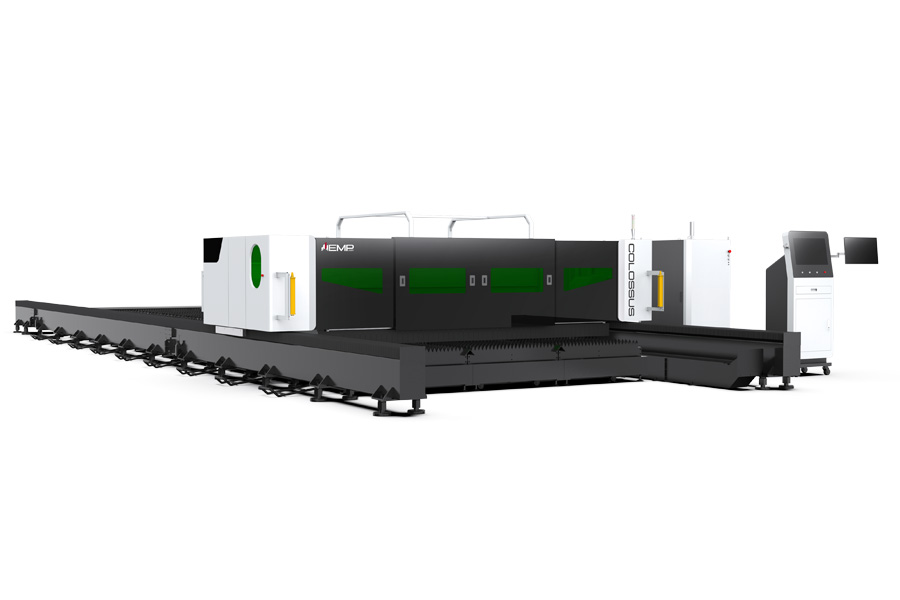
Colossus 25 / 32 / 40 |
Large-format plate where footprint governs — tooling bases, ground support equipment plate, large weldment plate. Non-flight fabrication | Flat plate — steel, stainless, aluminum | Widths to 13 ft, lengths extending to 72 ft; series configurable from 6 to 200 kW, with the published Colossus 32 (CL32140) configuration listing 6, 12, 20, 30, and 40 kW at a 10.66 × 47.57 ft working area; positioning ±0.004 in., repeatability ±0.002 in.; optional 45° V/X/Y/K bevel | |
Command 3015 / 4020 / 6020 |
Production sheet nests needing enclosure and continuous load and unload | Flat sheet and plate | 6020 working area 19.85 × 6.67 ft with 6–40 kW published for that model; power options for the 3015 and 4020 are not published; positioning ±0.001 in., repeatability ±0.0008 in.; fully enclosed; dual-platform exchange table | |
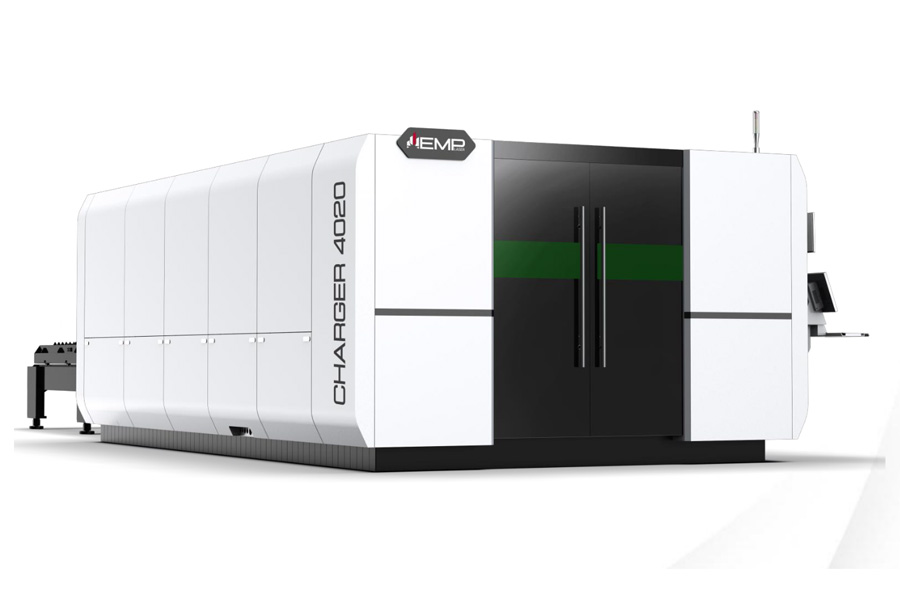
Charger 4020 |
Higher-speed enclosed sheet production on a 4 m-class bed | Flat sheet and plate | 13.3 × 6.7 ft working area; 6–40 kW; 2.8 G, 131.2 in/sec; CE OD4+ safety glass and camera monitoring; dual-platform exchange table | |
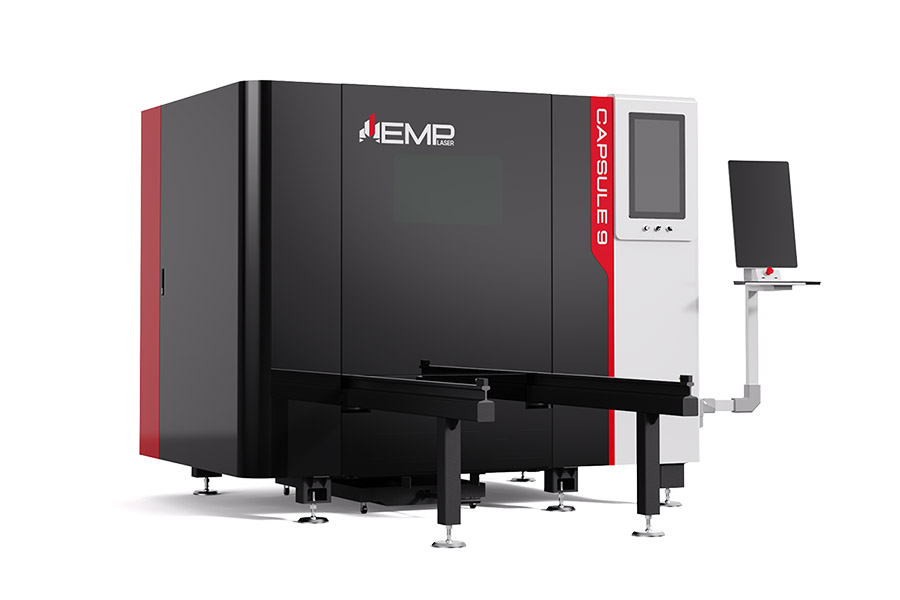
Capsule 9 / 13 / 15 |
Small-format precision work — brackets, sensor mounts, small fixtures — where containment matters more than exchange-table throughput | Flat sheet | Work areas 35.4, 51.2, and 59.1 in. square; 1.5 / 3 / 6 kW; positioning ±0.03 mm, repeatability ±0.02 mm; 1.2 G; fully enclosed with automatic lifting door and electromagnetic slide-out bed | |
Cypher 6012 |
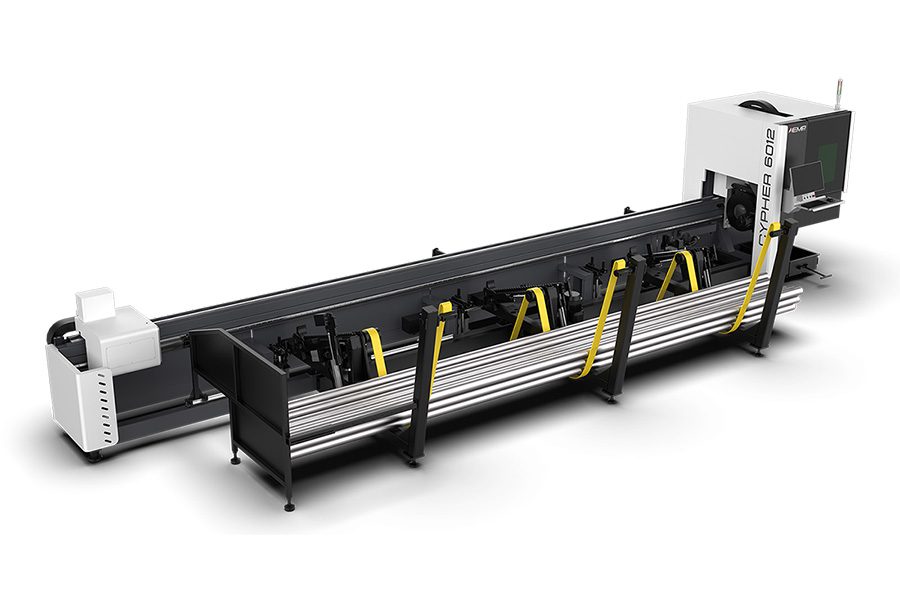
Small-diameter tube for GSE, test rigs, tooling frames, cargo and seat structures — not primary flight fluid lines | Round tube 0.4–4.72 in. | Max tube length 21.32 ft; 1.5–3 kW; 200 rpm; 1.18 in. minimum tailing; semi-automatic or fully automatic feeding | |
Fiber, MOPA & UV Markers |
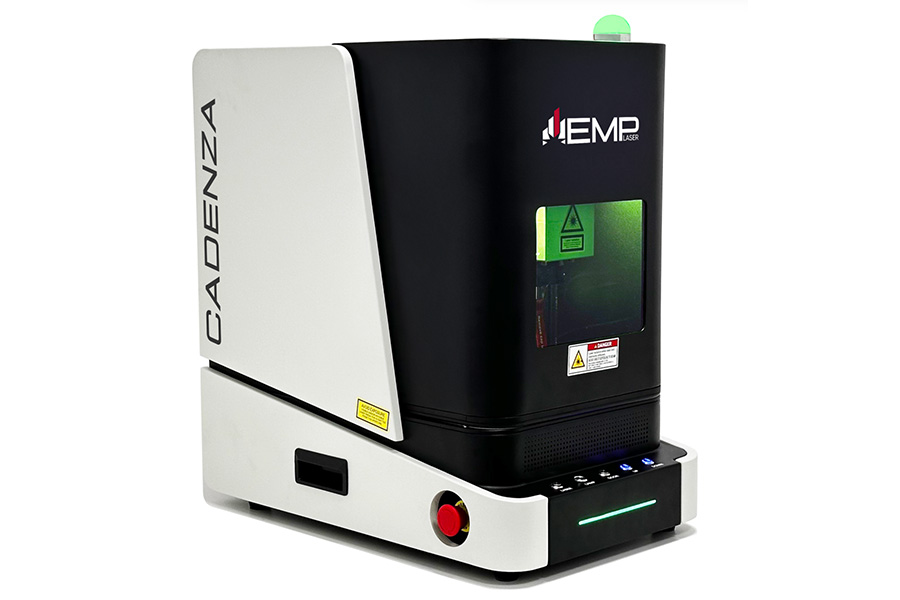
Serials, part numbers, barcodes, and Data Matrix IUID marks | Metals; UV marks selected non-metals | Fiber 30 / 50 W; MOPA 60 / 100 W; UV 5 / 10 / 15 W; Cadenza 30 / 60 / 100 / 200 W |
Specifications are published machine figures rather than achievable finished-part tolerances, and they are model- and configuration-specific — confirm them for the configuration you are quoting. Note that the plate and sheet categories are not interchangeable on accuracy: the ground-rail plate machine publishes positioning roughly four times coarser than the enclosed sheet machines, which is expected on a gantry of that span. If a fixture or jig carries a tolerance callout, check it against the specific machine rather than against the category.
How We Work
From expert planning, delivery and installation to service, training and calibration, EMP Laser provides fast, reliable and professional support.
FAQs
General
Laser cutting in aerospace is used for sheet and light-gauge metal parts where the drawing accepts a thermal cut edge — brackets, panels, covers, housings, shields, mounting hardware, and shop tooling and fixtures. Fatigue-critical structural details may still be laser-blanked and finished to the drawing rather than shipped as-cut.
Fiber lasers can cut aluminum including 2xxx and 7xxx structural grades, stainless grades called out on the drawing, carbon steel for tooling and ground support equipment, titanium, and nickel superalloys such as Inconel 718 and 625 — each with the assist gas and economics constraints covered in the materials section. Fiber lasers are the wrong bulk-cutting tool for CFRP, glass, ceramics, and most plastics.
Yes, fiber lasers can cut titanium with process control — and assist gas rather than wattage dominates the decision. Oxygen and air produce poor structural edges; nitrogen forms hard, brittle nitride and alpha-case layers that may need machining off; argon is inert when an inert shield is required12,13. The materials section covers the mechanism, and notes that magnitudes from CO₂ studies are not fiber production allowables.
On sheet gauge, yes — we list nickel alloys among the metals our fiber laser systems cut33, and Inconel 718 is a nickel-iron-chromium superalloy used in hot-section engine hardware15. As thickness, heat input, edge-metallurgy requirements, or total cost including finishing rise, abrasive waterjet, conventional machining, or wire EDM become the economical path. We found no public thickness figure marking that transition for every drawing.
No. Laser cutting of CFRP is a thermal process, and published work reports heat-affected zones, charring, resin recession, delamination, and fiber damage from thermal mismatch between fiber and matrix16. Aerospace composite parts are cut by abrasive waterjet, ultrasonic cutting, or mechanical routing and milling instead16,31. If your part mix combines metal and composite, we can help work through which processes belong in-house.
Secondary finishing on aerospace parts depends on whether the part is fatigue-critical. Non-critical covers, shields, brackets, and ducting carrying only local loads are released once geometry and edge appearance meet the drawing. Fatigue-critical details carry edge-condition callouts, and the approach is to laser-cut a blank slightly oversized at the critical edge and finish to the drawing — deburr, edge break, etch, or machine-to-finish. On non-critical work with a tuned cut and the correct assist gas, secondary work can be minimal.
Quality and Standards
It can be. Laser Beam Machining sits within Nadcap's Nonconventional Machining program, with cutting listed among the laser operations, audited against the AC7116 series7. Accreditation applies when a customer flows the requirement down; absent that, the contract's own quality requirements govern. Where it does apply, the company performing the process holds it rather than the machine6, and the commitment sits in the quality system rather than the equipment purchase.
No. AS9100 is a quality management system standard for aviation, space, and defense organizations. It adds requirements over an ISO 9001 system and is held by the organization after third-party audit4,5. A shop holds AS9100 certification; its machines do not. What matters is whether the machine supports the shop's documented processes — repeatable output, controlled parameters, and a workflow that preserves material traceability. If a machine is described as AS9100 certified, ask what the certificate actually covers.
MIL-STD-130 is the DoD standard for identification marking of U.S. military property, covering free text and machine-readable information including unique item identification with Data Matrix symbols23,24. It applies when DoD IUID clauses flow down. Marks must remain readable through normal life cycle and not harm functional performance; laser discoloration, etching, and engraving are listed methods23. Commercial aviation references ATA Spec 2000 Chapter 9 instead25.
Treat material traceability as a production workflow rather than a software checkbox. A nested sheet yielding many parts from one heat needs controlled staging, nest-to-lot records, and on-table identification or controlled kitting. Neither CypCut nor Bochu TubePro is published as offering MES or heat-lot traceability capability, so confirm what your configuration does before building a workflow on it. Pair the cutter with a marking process where the drawing or contract requires permanent part identity.
Other Laser Processes
Yes, laser welding can be used for certain applications — thin-section assemblies, housings, and small precision joints are where it comes up. Whether it is appropriate depends on the material, joint design, section thickness, and the qualification requirements the part carries. Aerospace welding is a separate Nadcap accreditation from nonconventional machining — PRI lists Welding among its critical process accreditations, and the Nadcap Welding Task Group's audit criteria are the AC7110 series6,28. A welding accreditation requirement is a distinct commitment from anything a shop already holds for cutting. We do not manufacture laser welding systems. If you are evaluating whether laser welding fits your production, we can talk through the process requirements even though the equipment is not ours.
Laser cleaning is used in aerospace primarily for surface preparation ahead of bonding, coating, or repair, and for paint, oxide, and contaminant removal where abrasive or solvent methods are undesirable. U.S. Air Force–sponsored work evaluated pulsed laser cleaning to remove paint, contaminants, and oxides from aluminum, stainless steel, and titanium, and as a pretreatment path for adhesive bonding29. NASA has evaluated Nd:YAG laser surface preparation of aerospace structural composites prior to bonding as an alternative to grit blast, manual abrasion, or peel ply30. Suitability depends on the substrate, the coating or contaminant being removed, and the surface condition the downstream process requires. We do not manufacture laser cleaning systems, but we can help determine whether laser cleaning is the right approach for an application.
Laser cladding, also called laser-based directed energy deposition, adds material to a surface rather than removing it. That puts it in the repair and remanufacturing world rather than in blanking production, and any use of it on a flight component sits under the repair approvals and process qualifications that component carries. We do not manufacture laser cladding systems. For repair-focused operations, we can point you toward the right process even where it is not equipment we sell.
EMP Support
Installation and calibration, operator and maintenance training, and tailored service and support contracts, starting from a consultation covering current workflow, bottlenecks, and production plans. Training covers operation, maintenance, safety, and advanced features so your crew can run the machine without depending on the installer after handoff.
Yes, through a third-party lender. See our financing page for current options and terms. We are not the lender; agreements are between the customer and the financing provider.
Ready to Get Started?
Our team can help you compare machine configurations, work through alloy and assist-gas requirements, and choose a laser cutting solution built around your production goals.
Talk to Our Team

Sources
- SAE International, AS9102A, Aerospace First Article Inspection Requirement, issued 2000-08, revised 2004-01: https://img.antpedia.com/standard/pdf/V00/1703/SAE%20AS%209102A-2004_809.pdf — Source-class note: hosted reproduction rather than SAE's own copy, and Revision A is superseded. SAE lists AS9102C, revised June 28, 2023, as the current revision [35]. Cited for the FAI purpose statement, which the current IAQG guidance [2] also supports; no clause-level requirement is drawn from it.
- International Aerospace Quality Group, First Article Inspection 9102 FAQ: https://iaqg.org/wp-content/uploads/2019/10/9102-FAQ.pdf — full official text.
- Acquisition.gov, DFARS 252.225-7009, Restriction on Acquisition of Certain Articles Containing Specialty Metals (JAN 2023): https://www.acquisition.gov/dfars/252.225-7009-restriction-acquisition-certain-articles-containing-specialty-metals — full official text.
- International Aerospace Quality Group, 9100 Quality Management Systems — Requirements for Aviation, Space and Defense Organizations: https://iaqg.org/standard/9100-qms-requirements-for-aviation-space-and-defense-organizations/ — official scope description; the standard itself is paywalled.
- NSF, AS9100 Series: Quality management certification: https://www.nsf.org/management-systems/quality-management/as9100 — Source-class note: certification body rather than the standards body; cited for the organizational-certification framing only.
- Performance Review Institute, Nadcap Accreditation: https://www.p-r-i.org/nadcap/accreditation — full official page.
- Performance Review Institute, Nonconventional Machining program information sheet: https://brx-content.fullsight.org/site/binaries/content/assets/p-r-i-org/nadcap/pri-nonconventional-machining-info-sheet.pdf — full official text. Confirms the program's process list, that Laser Beam Machining is used for cutting, drilling, and marking operations, and the AC7116 series. Source-class note: the checklist revision letters are not stated in this document and are not asserted here.
- eCFR, 22 CFR Part 121, The United States Munitions List: https://www.ecfr.gov/current/title-22/chapter-I/subchapter-M/part-121 — full official text.
- eCFR, 15 CFR Part 730, General Information (Export Administration Regulations): https://www.ecfr.gov/current/title-15/subtitle-B/chapter-VII/subchapter-C/part-730 — full official text. §730.1 states BIS authority, §730.3 defines dual-use items, §730.7 locates the Commerce Control List at Supplement No. 1 to Part 774.
- ASM International, Aluminum and Aluminum Alloys Subject Guide: https://www.asminternational.org/aluminum-and-aluminum-alloys-subject-guide/
- National Academies Press, New Materials for Next-Generation Commercial Transports, Chapter 3, Metallic Materials and Processes: https://www.nationalacademies.org/read/5070/chapter/5
- Andersson, N. and Granberg, C., Laser cutting in Ti-6Al-4V sheet: Design of experiments and evaluation of process parameters, Chalmers University of Technology / GKN Aerospace, Diploma work 164/2015: https://odr.chalmers.se/server/api/core/bitstreams/212a684c-ccad-4875-93e0-b1116f12816a/content — Laser type and era: 4 kW CO₂, 2015. Magnitudes are not fiber production allowables.
- Poshyananda, V. et al., Consideration of key process parameters for achieving robust and uniform cutting of Ti-6Al-4V sheet metal using fiber laser with nitrogen assisted gas, Journal of Metals, Materials and Minerals 28(2), 2019: https://jmmm.material.chula.ac.th/index.php/jmmm/article/view/375 — Laser type and era: fiber, 2019.
- NASA Technical Reports Server, aluminum alloys in aerospace applications, document 20180001137: https://ntrs.nasa.gov/api/citations/20180001137/downloads/20180001137.pdf
- ScienceDirect Topics, Inconel 718 overview: https://www.sciencedirect.com/topics/materials-science/inconel-718 — Source-class note: secondary literature summary rather than a primary specification. Cited for qualitative application only; no numeric temperature or strength claim is drawn from it.
- Arshed, F. et al., Laser cutting of carbon fiber reinforced plastic components for remanufacturing, Journal of Remanufacturing 12, 411–433, 2022: https://link.springer.com/article/10.1007/s13243-022-00117-6 — peer-reviewed.
- ScienceDirect, A novel method to reduce dross in laser beam cutting of Ti-6Al-4V alloy sheet, 2021: https://www.sciencedirect.com/science/article/abs/pii/S1526612521000396 — Source-class note: paywalled abstract. Laser type, thickness, and sample size are not stated on the accessible page. Cited only for the general dross-to-HAZ relationship.
- Air Force Materials Laboratory / Boeing Commercial Airplane Company, Feasibility of Cutting Aluminum Alloys with a 6-Kilowatt Laser, AFML-TR-77-66, 1977: https://apps.dtic.mil/sti/tr/pdf/ADA051838.pdf — Laser type and era: 6 kW coaxial electric-discharge CO₂, 1977; specimens cut at 3.5 kW with air assist. Aluminum only. The 0.005 in. figure is the report's achievable bound under optimized parameters, not a measured maximum.
- Whitesel, D.A., The effects of laser trimming on the tensile strength and fatigue resistance properties of titanium-6Al-4V, Texas A&M University, 1994: https://oaktrust.library.tamu.edu/items/ed5b60b0-daae-43cc-9763-568076a61297 — Laser type and era: not stated in the available text; era almost certainly CO₂. The inference is labeled as inference in the body.
- NASA Johnson Space Center, JSC-67701, JSC Fabrication Tolerances and Practices, Basic DCN 001, 2025: https://standards.nasa.gov/system/files/tmp/JSC-67701_JSC_Fabrication_Tolerances_and_Practices_Basic_DCN001_Final.pdf — Source-class note: general fabrication standard that does not address laser cutting. Its edge-finishing requirement is cited by analogy to sheared and blanked edges.
- The Fabricator, Deburring: A standard operation?: https://www.thefabricator.com/thefabricator/article/finishing/deburring-a-standard-operation- — Source-class note: trade press, adapted from SME's Deburring and Edge Finishing Handbook. No publication date stated.
- The Fabricator, Tech Topic: Avoid deburring when laser cutting sheet metal: https://www.thefabricator.com/thefabricator/blog/lasercutting/tech-topic-avoid-deburring-when-laser-cutting-sheet-metal — Source-class note: trade press. No publication date stated. This is the one fiber-laser-specific process citation in the edge-quality section.
- U.S. Department of Defense, MIL-STD-130N w/Change 1, Identification Marking of U.S. Military Property, 16 November 2012: https://cvgstrategy.com/wp-content/uploads/2023/04/MIL-STD-130N-Change-1.pdf — Source-class note: third-party mirror of the standard rather than a DoD-hosted copy.
- NSWC Corona IUID Center, Item Unique Identification (IUID) Marking, 3 May 2016: https://dodprocurementtoolbox.com/uploads/IUID_Marking_May2016_2cc81b149a.pdf — official DoD presentation.
- Airlines for America / ATA e-Business Program, Standards (Spec 2000 Chapter 9, Automated Identification and Data Capture): https://ataebiz.org/standards/
- OSHA, Hexavalent Chromium — Overview: https://www.osha.gov/hexavalent-chromium — full official page. No numeric permissible exposure limit is stated in the body; the figure was not returned in the accessible extract.
- OSHA, 29 CFR 1910.1026, Chromium (VI): https://www.osha.gov/laws-regs/regulations/standardnumber/1910/1910.1026 — full official regulation.
- Performance Review Institute, Welding: Nadcap Audit Criteria Review: https://www.p-r-i.org/courses/welding-nadcap-audit-criteria-review-wldnacr — official PRI course description identifying the Welding Task Group and the AC7110 series.
- U.S. Air Force / Defense Technical Information Center, Laser Surface Preparation for Adhesive Bonding II, ADA456115: https://apps.dtic.mil/sti/tr/pdf/ADA456115.pdf
- NASA Technical Reports Server, Belcher et al., Laser Surface Preparation and Bonding of Aerospace Structural Composites, document 20100021129, 2010: https://ntrs.nasa.gov/citations/20100021129 — Source-class note: Nd:YAG laser on composites, not fiber cleaning equipment. Cited for the process class.
- Finepart, Waterjet Cutting Carbon Fiber: https://www.finepart.com/how-to-cut/waterjet-cutting-carbon-fiber/ — Source-class note: equipment supplier's process comparison rather than peer-reviewed literature. Cited only for the names of the alternative processes, alongside [16].
- EMP Laser, Fiber Laser Marking Machines: https://emplaser.com/fiber-laser-marking-machine — our own product page.
- EMP Laser, Fiber Laser Cutters: https://emplaser.com/fiber-laser-cutter — our own hub page, cited for CypCut function scope.
- EMP Laser, EMP Cypher High-Speed Fiber Laser Tube Cutter: https://emplaser.com/emp-cypher-high-speed-fiber-laser-tube-cutter — our own product page, cited for Cypher specifications and the Bochu TubePro with TubesT software pairing.
- SAE International, AS9102C, Aerospace Series — First Article Inspection Requirements, revised June 28, 2023: https://saemobilus.sae.org/standards/as9102c-aerospace-series-first-article-inspection-requirements — catalog listing identifying the current revision. Source-class note: the standard text is paywalled; this entry establishes the revision status of [1] only.