
What Makes Trailer Manufacturing Different
A trailer builder is a vehicle manufacturer
A trailer built for the road is a motor vehicle under federal law, and the company that builds it is a vehicle manufacturer. NHTSA does not approve trailers before sale; the manufacturer certifies that each one conforms to the Federal Motor Vehicle Safety Standards (FMVSS) that apply to it4. A new manufacturer also has to identify itself to NHTSA within 30 days of starting production5. The next section covers what those duties mean for the shop floor.
One shop, every format
A single trailer can draw on every stock format a fabrication shop handles. Sheet becomes fenders, skins, stone guards, and toolboxes. Plate becomes gussets, hitch plates, spring-hanger plates, and crossmember plates. Tube and profile become tongues, rails, crossmembers, and ramps. That mix is why machine choice starts with format rather than with power or speed.
Long members set the envelope
The main beams and side rails of a trailer run along its length, and some of the longest parts in the shop are cut for them. How those members are built, and whether any given machine can cut them in one piece, is covered in its own section below.
The materials go past structural carbon steel
High-strength steel in load-bearing members, abrasion-resistant (AR) plate in dump bodies, aluminum, and galvanized stock each change what the cut edge does to the part and what happens to it next.
Farm trailers split in two
NHTSA does not treat every vehicle towed on a farm as a motor vehicle. Its interpretations have excluded vehicles with a maximum speed of 20 mph and a configuration that readily distinguishes them from highway traffic — equipment sometimes called an implement of husbandry — while treating a vehicle that spends substantial time on the road as a motor vehicle6. The federal content in this article applies to the second kind. The fabrication content applies to both.
Adjacent work
Truck-body builders — dump, flatbed, and service bodies — share much of this plate and profile workflow.
Shop versus field
The systems in this article are fixed shop equipment. Roadside and yard repair, and modification of trailers in service, are a different toolset.
Federal Requirements That Touch the Cut and the Mark
The rules certify the vehicle, not the machine
Federal motor vehicle safety standards are performance requirements for the finished vehicle, and the manufacturer self-certifies to them4. NHTSA does not approve vehicles or equipment4, so calling a cutting or marking machine "DOT approved" or "FMVSS compliant" describes nothing the agency does. Between a cut part and a certified trailer sit the design, the welding procedure, inspection, and the builder's records. A machine's positioning accuracy and repeatability describe what its axes do under test; they are not the tolerance a finished part will hold, and they are not evidence that a trailer conforms.
Which rules apply to which builder
| Rule | What it covers | Who it applies to |
|---|---|---|
| 49 CFR Part 565 | VIN content and how it is displayed | Manufacturers of trailers that are motor vehicles1 |
| 49 CFR Part 567 | Certification label content, placement, and permanence | Manufacturers of trailers that are motor vehicles2 |
| FMVSS 224 | Rear impact guard installation | Trailers and semitrailers of 10,000 lb (4,536 kg) gross vehicle weight rating (GVWR) or more, with listed exclusions7 |
| FMVSS 223 | Rear impact guard strength, energy absorption, and labeling | Guards for trailers subject to FMVSS 2243 |
| Motor-vehicle definition | Whether any of the above applies | Excludes farm equipment with a maximum speed of 20 mph and an abnormal configuration; includes farm trailers with substantial road use6 |
GVWR is the maximum loaded weight the manufacturer rates the trailer for. A light utility-trailer builder working below 10,000 lb GVWR is outside the rear impact guard standards, and the builder of a heavy trailer is inside them.
Rear impact guards are certified by test
FMVSS 224 requires covered trailers to carry a rear impact guard certified to FMVSS 223, and sets where the guard sits7. FMVSS 223 certifies the guard by strength and energy-absorption tests on the guard as installed or on a rigid fixture3. The standard specifies loads, deflection, and ground clearance. It does not specify how the guard's parts are cut or welded. A builder that makes its own guards is the guard manufacturer for the purposes of the standard, and must prepare installation procedures for each trailer and guard combination, keep them for one year from the date of vehicle manufacture, and provide them to NHTSA on request3.
Welding codes
We did not find a federal rule that mandates a welding code for trailers. The code a builder works to comes from its own quality system, its customers' specifications, or both. AWS D1.1 covers welded structures made from the commonly used carbon and low-alloy constructional steels8; whether a particular high-strength grade sits within the edition you work to is a question for the code text and the steel producer. For what D1.1 and AISC ask of a thermally cut edge, see our construction fabrication article.
Industry programs
The National Association of Trailer Manufacturers (NATM) runs a Compliance Verification Program that is mandatory for its trailer-manufacturing members, with a consultant visiting each member facility every two years to review its manufacturing processes against applicable federal regulations and industry best practices9. It binds NATM members, not the industry as a whole, and we did not find its checklist published.
Trailer Steels, Aluminum, and Coatings
The question for trailer material is not whether a fiber laser can cut the grade. It is what the cut does to the edge, and what the edge has to do next — carry load, take a weld, or go into a galvanizing kettle.
| Material | Trailer use | Cutting considerations | Assist gas |
|---|---|---|---|
| Structural carbon steel — plate, channel, rectangular tube | Frames, crossmembers, tongues, brackets | Mill scale condition affects cut stability; see our construction fabrication article | Oxygen or nitrogen, by thickness and the edge the next operation needs |
| High-strength and heat-treated steel | Main-beam flanges and other load-bearing members | The cut leaves a heat-affected zone; how much it matters depends on the grade — see below | Set by the grade and the producer's guidance |
| Abrasion-resistant plate | Dump bodies and wear liners | Producer guidance differs by cutting process — see below | Set by the grade and the producer's guidance |
| Galvanized and pregalvanized steel | Frames, crossmembers, and components built for corrosion resistance | The cut edge is bare steel, and the fume is a regulated exposure | Extraction specified against the coating |
| Aluminum sheet and plate | Skins, floors, fenders, and aluminum trailer structure | Alloy, temper, and thickness decide the parameters | Nitrogen10 |
High-strength steel and the heat-affected zone
Load-bearing trailer members can use steels well above structural grades. A 2026 NHTSA recall report documents flatbed main-beam flanges in 130 ksi and 100 ksi high-strength steel grades11.
Every thermal cut leaves a heat-affected zone (HAZ): the band of base metal whose structure the cutting heat has altered. SSAB's trailer design guideline, written for its own high-strength grades, states that modern laser and high-definition plasma cutting generally produce edges with good fatigue properties in its Strenx 700MC grade, and ranks laser, plasma, and gas cutting in that order12. A 2016 study of 15 mm S640M structural steel found the narrowest HAZ with laser cutting among oxyfuel, plasma, and laser13; the accessible abstract does not state the laser type or give the HAZ widths.
Neither source is a test of your grade. The guideline is a steel producer's guidance for its own steel, and the study used a different grade and thickness from trailer flanges. For a load-bearing edge that stays in service as cut, confirm cutting practice with the steel producer and your design engineer, and qualify it on the grade and thickness you run.
Abrasion-resistant plate
SSAB's cutting guidance for its Hardox wear plate states that laser cutting needs no preheating or postheating, and that preheating is detrimental to laser cut-edge quality14. The same guidance gives preheat recommendations for oxyfuel cutting that vary by grade and thickness, and notes that plasma cutting thick plate with oxygen as the plasma gas may need preheating or postheating14. It puts laser cutting of Hardox at up to roughly 30 mm (1.18 in.), depending on the equipment14.
That is one producer's guidance for its own grades. For another producer's AR400, AR450, or AR500-class plate, check that producer's cutting recommendations before assuming the same practice transfers.
Aluminum
Alloy, temper, and thickness all move the parameters on aluminum, and nitrogen assist is used for aluminum plate10. AWS D1.2 is the structural welding code for aluminum structures15. Its requirements for edges before welding are in the code text rather than in any summary, so check them in the edition your work is built to.
Galvanized stock
Galvanized steel can be cut on a fiber laser, but not as though it were bare steel. The cut face is uncoated and the fume is zinc-bearing. Our construction fabrication article covers edge repair, galvanizing after fabrication, and the extraction limit.
What a fiber laser does not process
These are metal-cutting systems. Wood and composite decking, rubber, and plastic liners need a process suited to them.
Long Members, Frames, and the Length Envelope
How long members are built
On heavier trailers, the main beams — the two longitudinal members that carry the load — can be built up from plate: a vertical web welded between top and bottom flanges. SSAB's trailer design guideline recommends a single piece for the flanges and the web throughout the full length of the trailer12. Where a builder follows that practice, the longest parts in the shop are plate strips as long as the beam.
Where a frame, tongue, or crossmember is built from channel, rectangular tube, or angle, it is cut as a profile rather than from flat plate.
That gives two routes to a long member, and each has its own envelope. A web or flange is cut from plate, so plate length governs. A rail or tongue is cut as a section, so maximum tube length and section size govern.
The length question
Federal truck-size rules do not let a state set a length limit below 48 feet on a semitrailer in a tractor-semitrailer combination, and several states allow longer semitrailers under grandfathered limits16. Those rules govern highway operation, not manufacture, but they size the problem: a single-piece beam in a full-length semitrailer is a long piece of plate.
The principle is simple and worth applying before any other comparison. Your longest recurring member decides the envelope you need. A member longer than the machine's envelope is spliced by design, cut on another process, or not a laser job on that machine. The machine section below gives our published figures.
Profile size is the second envelope
For channel and rectangular rails, section size decides fit as much as length does. A round-diameter figure does not tell you what rectangular or channel section a tube machine will hold, so size profile work against the profile, not the round range.
Handling and floor space
Long stock needs infeed and outfeed length, support along its span, and a way to lift and stage it safely. Plan the floor for your longest member, not the average one.
Bevel, where the joint calls for it
A bevel matters where the joint design calls for a groove weld; a fillet-welded joint does not need one. Where bevels are needed, cutting them on the machine can remove a separate edge-preparation step.
VINs, Certification Labels, and Part Marking
What the rules require of a mark
Three federal requirements put identifiers on a trailer, and each is written as an outcome.
The VIN
The VIN must appear clearly and indelibly, either on a part of the trailer not designed to be removed except for repair, or on a separate plate or label permanently affixed to such a part1.
The certification label
The label must be riveted or permanently affixed so that it cannot be removed without destroying or defacing it. On a trailer, it goes on the forward half of the left side, readable from outside. Its lettering must contrast with the background and be block capitals and numerals at least 3/32 in. high2.
The rear impact guard label
Each guard must be permanently labeled with the guard manufacturer's name and address, the month and year of manufacture, and "DOT," in letters at least 2.5 mm high, on the forward- or rearward-facing surface of its horizontal member3.
None of these names a marking method. A laser mark, a stamp, or an attached plate can each be a way to meet them; the test is whether the mark you produce is indelible, permanent, contrasting, and legible on your material and finish.
Contrast and permanence are the tests
On stainless steel, a fiber laser can produce a colored or dark mark by annealing — a controlled oxidation of the surface17 — and our galvo markers with JPT and MOPA sources are described for annealing on stainless steel18. On bare and anodized aluminum and on painted plate, contrast depends on the substrate and the coating. Mark the plate material you intend to use and check it against the label requirements before committing to it.
Marks that go under a coating
Guard labels and frame marks sit on parts that may be painted, powder coated, or galvanized after marking. We did not find published data on laser-mark legibility after those finishes. The validation step is a coupon: mark the actual material, run it through the actual coating sequence, and read it.
Part IDs for kitting and assembly
Where many parts come off one nest, a part ID carries each piece to the right weldment. We did not find a federal requirement for part-level traceability on trailers; how far you carry it is a decision for your quality system and your customers.
What our software does
CypCut handles machine control and computer-aided manufacturing (CAM) on our sheet and plate machines: DXF import, nesting, path optimization, edge finding, autofocus, and cutting parameter management19. Bochu TubePro with TubesT nesting is the tube-side equivalent20. Neither package is published as offering manufacturing execution system (MES) or traceability capability. If your workflow depends on the cutting software carrying serial or part records, ask us what a specific configuration does.
Where Laser Cutting Fits — and Where It Doesn't
| Application | Example components | Machine category |
|---|---|---|
| Flat plate parts | Gussets, hitch plates, spring-hanger plates, crossmember plates, gooseneck and coupler plates | Sheet cutters; ground-rail plate cutters for oversized plate |
| Long plate | Main-beam webs and flanges, side rails, deck plate | Ground-rail plate cutters, within the configured length |
| Sheet components | Fenders, skins, stone guards, toolboxes, panels | Sheet cutters |
| Tube and profile | Tongues, rails, crossmembers, ramps | Tube cutters and multi-chuck profile cutters |
| Light tube | Gates, rails, ramp and fence components | Small-diameter tube cutters |
| Weld preparation | Beveled plate and profile ends where the joint calls for a groove weld | Plate and tube cutters with bevel configuration |
| Identification | VIN plates, certification labels, part IDs | Fiber, MOPA, and UV markers17 |
Where a laser is not the answer
Members longer than the machine's envelope
Where your longest web, flange, or rail exceeds a machine's published length, the options are a splice designed into the member, a longer configuration quoted for the job, or another process.
Straight cut-to-length only
If the work is square cuts on stock with no holes, slots, or profiles, a saw or cutoff machine can be the more economical tool. A tube laser earns its cost where it replaces several operations with one program.
Thick carbon and AR plate with modest tolerance
There is no single thickness at which a laser stops making sense against plasma or oxyfuel. Material, required edge, tolerance, cycle time, secondary work, and capital already on the floor all move it, so a crossover figure is only as good as the cost model behind it.
Forged, cast, and purchased components
If you buy in kingpins — the pin on a semitrailer's upper coupler that engages the tractor's fifth wheel — along with axles, couplers, jacks, and suspension assemblies, a laser cuts the plate and brackets they mount to, not the components themselves.
Non-metals
Wood and composite decking, rubber, and plastic liners.
Field and yard repair
These are installed shop systems.
If your requirement lands in this block, tell us — the recommendation should follow the requirement, including when it points away from a laser.
Choosing a Laser System for Trailer Manufacturing
This section has two parts. The first is for shops already running a thermal cutting table. The second is the set of requirements worth pinning down before you compare any two machines.
If You're Currently Cutting with Plasma or Oxyfuel
If you already run a plasma table, a burn table, or both, this is a supplement-or-replace decision rather than a first-machine decision.
What changes is edge condition, kerf width — the width of material the cut removes — and where finishing sits. On our own comparison, high-power laser systems can process many thick-wall applications with tighter tolerances and cleaner edges than plasma21. For one high-strength grade, Strenx 700MC, the producer's guidance ranks laser ahead of plasma and gas cutting for fatigue-relevant edge quality12. What plasma and oxyfuel still have is a lower upfront price21 and equipment that may already be paid for, and that is a real argument rather than a concession.
Keeping a burn table for heavy or rough work while adding a laser for parts that carry tolerance and edge requirements is a legitimate outcome.
What to Establish Before You Compare Machines
Each of these narrows the field, and format and length narrow it fastest.
Which formats you process
Sheet, plate, tube and profile, or a mix. This determines machine family before power, automation, or software enters the conversation.
Longest member and heaviest piece
Map your longest web or flange against the plate machine's working length, your longest rail against a tube machine's maximum tube length — a different figure from its maximum cut length — and your heaviest piece against the published per-piece load.
Profile sizes
Channel, rectangular, and H-section sizes against the profile types a machine handles. The only non-round section size we publish is the Cyclone 7020's 230 mm (9.06 in.) square22. For anything else, ask us for the figure on the model you are considering.
Thickness range
Thickness against the mix you run most, not the one you run occasionally.
Materials
High-strength, AR, aluminum, and galvanized stock each bring an edge, gas, or fume consequence, covered in the materials section.
Marking workflow
Plates and labels on a marker, part IDs on or off the cutting machine, and where coating sits in the sequence.
Bevel requirements
Bevel is a sizing decision. On our Colossus 32 (configuration CL32140), enabling bevel reduces X-axis travel from 127.9 in. to 98.4 in. and Y from 570.9 in. to 541.3 in., while Z increases from 5.9 in. to 16.5 in.23. On the tube side, bevel is an option on the Caliber C2 and C3/C420,24.
Volume and model mix
Whether automation is warranted by the volume and model mix you actually run.
Material handling and floor space
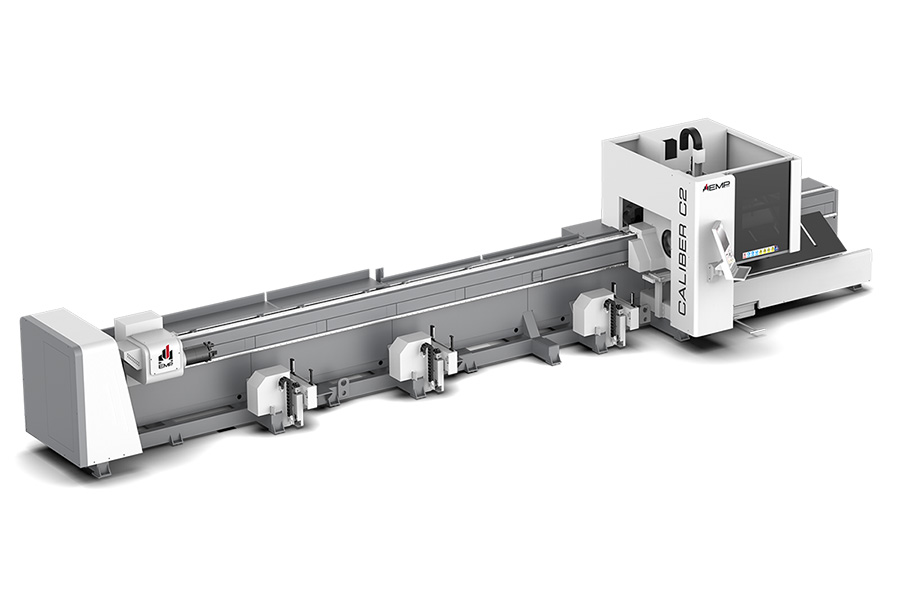
Long stock infeed and outfeed, lifting, and staging. The machine takes floor too: published machine dimensions for the Caliber C2 are 40.4 × 11.5 × 10.2 ft (6026) and 43.3 × 13.3 × 11.8 ft (6036)20.
Documentation
Certification records, welding procedures, and inspection records.
Support
Whether you will need operator and maintenance training, and ongoing technical support.
Our tube laser tonnage calculator is a starting point for tube sizing, and our guide to power and process parameters covers speed and thickness by material.
Ready for an assessment?
What we need from you
Work through the checklist above and reach out to our team. The more information you can provide, the better able we will be to make a specific recommendation rather than a general one.
What you can expect from us
Every engagement starts with a consultation covering current workflow, bottlenecks, and production plans — and we will recommend the right equipment whether or not it carries our name.
Built for Production, Backed by Experience
It's easier to enter the world of laser cutting with EMP by your side—even for those new to the technology, we provide expert installation, calibration, and training to ensure your machine is fully operational from day one.

Machine sourcing and configuration

Industrial-Grade Reliability and Quality Control

Custom Production Solutions

Professional Installation

USA-based Technical Support and Training

Flexible Support Contracts
EMP Laser Machines for Trailer Manufacturing
| Model | Best suited for | Formats and materials | Key specification | |
|---|---|---|---|---|
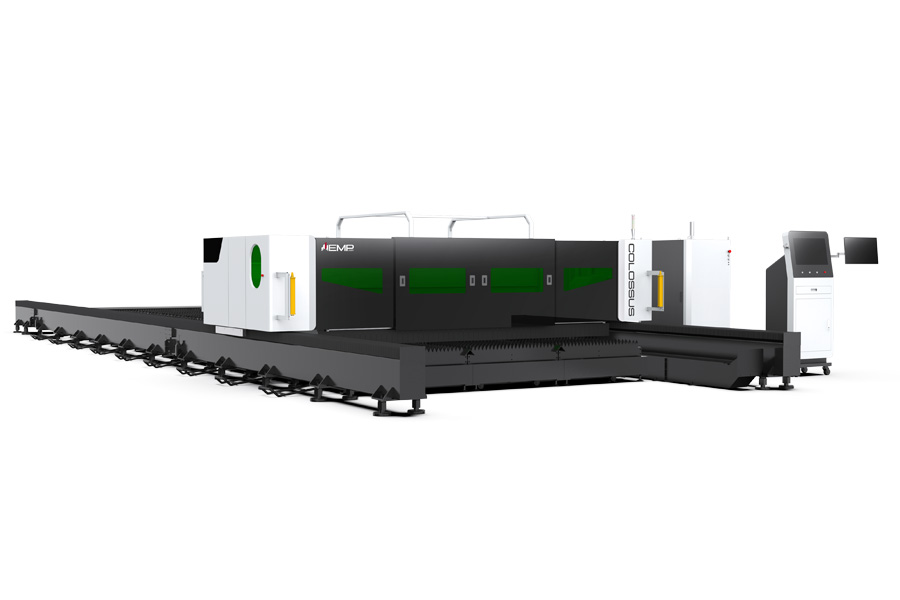
Colossus 25 / 32 / 40 |
Long plate where footprint governs — main-beam webs and flanges, gooseneck plate, deck plate | Flat plate — steel, stainless, aluminum | Widths to 13 ft, lengths extending to 72 ft; series configurable from 6 to 200 kW, with the published Colossus 32 (CL32140) configuration at a 10.66 × 47.57 ft working area; optional 45° V/X/Y/K bevel | |
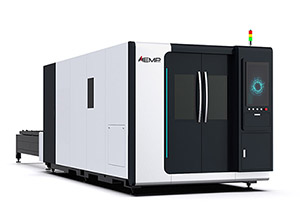
Command 3015 / 4020 / 6020 |
Plate and sheet parts at production volume — gussets, hitch and spring-hanger plates, crossmember plates, fenders | Flat sheet and plate | 6020 working area 19.85 × 6.67 ft; 6–40 kW; dual-platform exchange table | |
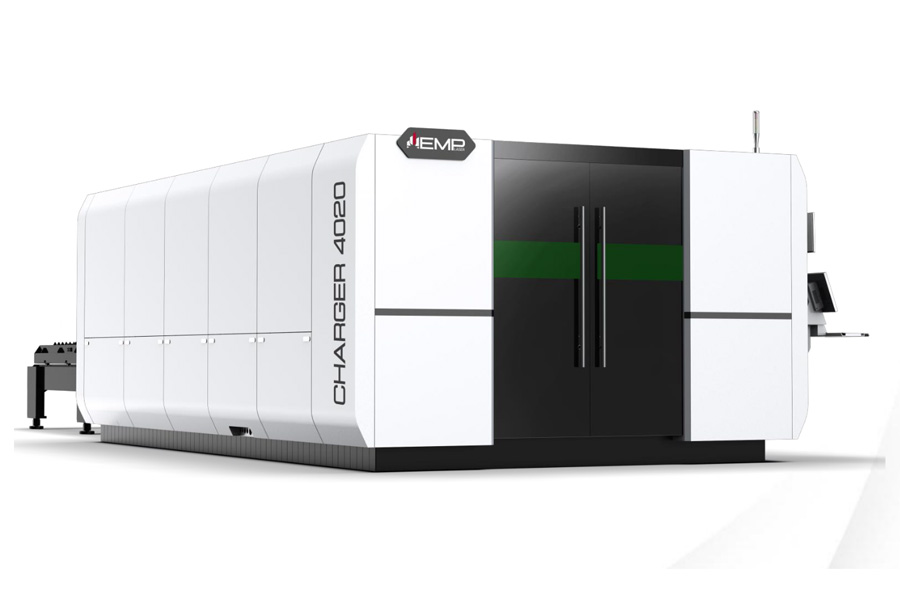
Charger 4020 |
Repeat sheet and plate parts where cycle time governs — brackets, fenders, stone guards, toolbox panels | Flat sheet and plate | 13.3 × 6.7 ft working area; 6–40 kW; 2.8 G, 131.2 in/sec; dual exchange table | |
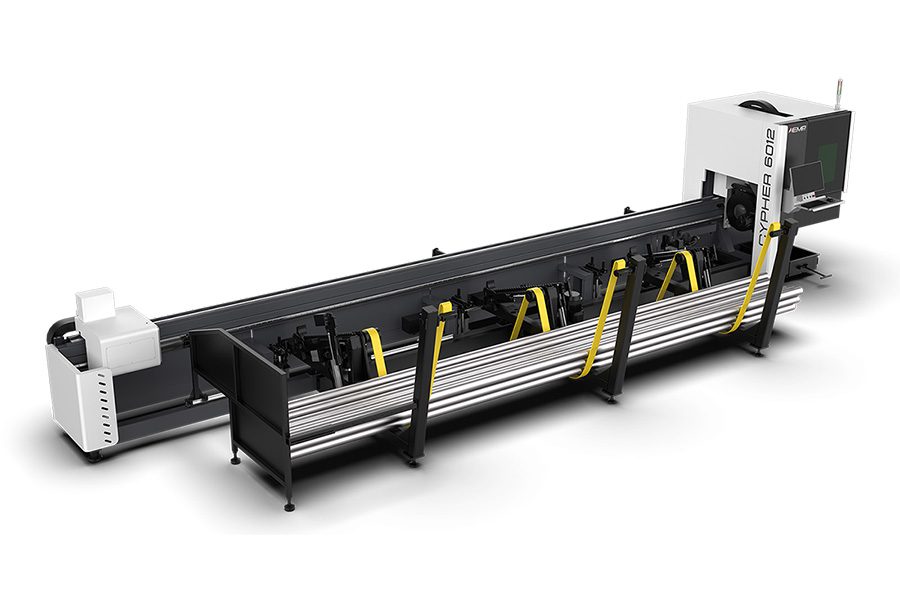
Cypher 6012 |
Light tube — gates, rails, ramp and fence components | Round tube 0.4–4.72 in. | Max tube length 21.32 ft; 1.5–3 kW; 200 rpm | |
Cyclone 7020 |
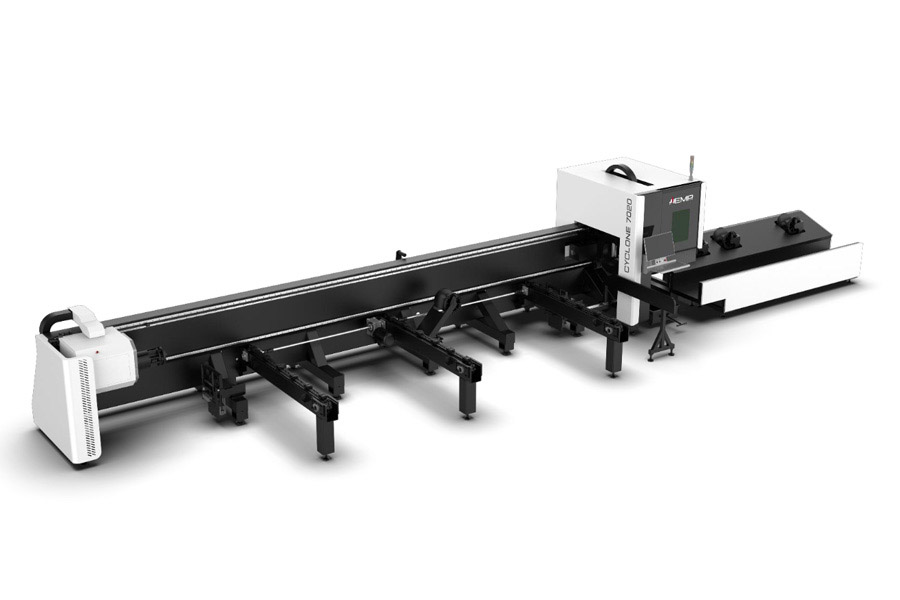
Tongues, crossmembers, and ramps in round and square tube | Round 0.6–9 in.; square to 230 mm (9.06 in.); rectangular and other profiles | Max tube length 24.6 ft; 1.5–12 kW; 661 lb max chuck load; automatic centering | |
Caliber C2 6026 / 6036 |
Heavier tube and H-section, with beveled ends and drilled and tapped holes | Round, square, rectangular, angle iron, H steel | Max round diameter 9.8 in. (6026) or 13.78 in. (6036); 6–30 kW; max tube length 21.9–40 ft (6026) or 22.3–40 ft (6036); max cut tube length 8.2, 14.7, or 19.6 ft; max load 1,102 or 1,543 lb per piece; optional 45° bevel and flow drilling and tapping | |
Caliber C3・C4 |
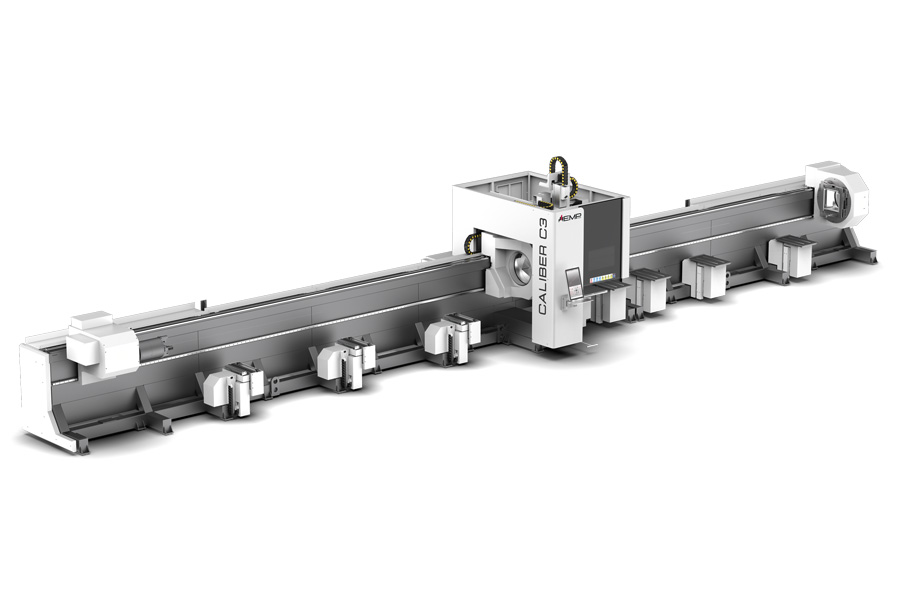
Long rails and structural profile at length | Round, square, rectangular, angle iron, H steel | Configurable 20–50 ft maximum tube length; 6–60 kW; the C4's fourth chuck is specified for zero tailing; optional 45° bevel | |

Fiber, MOPA & UV Markers |
VIN plates, certification labels, and part IDs | Metals; UV marks selected non-metals | Fiber 30 / 50 W; MOPA 60 / 100 W; UV 5 / 10 / 15 W; Cadenza 30 / 60 / 100 / 200 W |
Specifications are published machine figures rather than achievable finished-part tolerances, and they are model- and configuration-specific. Positioning accuracy differs by machine class — ±0.004 in. on the Colossus against ±0.001 in. on the Command 6020 and Charger 4020 — so confirm the figure for the machine you are quoting. The Colossus working area is a published configuration, not the series limit. Maximum tube length and maximum cut tube length are published as separate figures; ask us which one governs your part. Tailing is the unusable stub left at the end of a tube. Apart from round diameters and the Cyclone 7020's square capacity, we do not publish section sizes; ask us for the figure on the profile you run.
How We Work
From expert planning, delivery and installation to service, training and calibration, EMP Laser provides fast, reliable and professional support.
FAQs
The rules that put requirements on a trailer's structure and identifiers set outcomes — an indelible VIN1, a permanent, contrasting certification label2, a rear impact guard that passes its tests3 — and none of them names a cutting or marking method. The builder self-certifies the finished trailer4, so the method is the builder's to choose and to validate.
A laser marker can put text and codes on metal plate17. The rules set the outcome: the VIN clear and indelible1, the label permanent, with contrasting block characters at least 3/32 in. high2. Whether a particular mark meets those on your plate material and finish is what you validate before production.
It depends on the route. On plate, the published Colossus 32 configuration (CL32140) has a working area 47.57 ft long, and the series is configurable to lengths extending to 72 ft23. On profile, the Caliber C3/C4 is configurable for maximum tube lengths from 20 to 50 ft24. The Caliber C2's maximum tube length runs to 40 ft, and its maximum cut tube length is published separately, at 8.2, 14.7, or 19.6 ft20. Section size has to fit as well as length.
Every thermal cut leaves a heat-affected zone. One steel producer's guidance ranks laser ahead of plasma and gas cutting for fatigue-relevant edge quality in its Strenx 700MC grade12, and a study on a different structural grade found the narrowest HAZ with laser13. Neither is a test of your grade; confirm cutting practice with the steel producer and your design engineer.
Yes, within the machine's thickness range. One producer's guidance for its wear plate says laser cutting needs no preheat and that preheating harms laser cut-edge quality, while oxyfuel cutting may need preheat depending on grade and thickness14. Check your plate producer's cutting recommendations for your grade.
Yes, with nitrogen assist10 and parameters set for the alloy, temper, and thickness. Before welding, AWS D1.2 governs the aluminum structure; check its cut-edge requirements in the edition you work to.
Yes, though not as though it were bare steel. The cut leaves an uncoated edge and generates zinc-bearing fume. Our construction fabrication article covers the edge and the extraction requirement.
We did not find published data on laser-mark legibility after those finishes. Mark a coupon of your actual material, run it through your actual coating sequence, and read it before a marking step goes into production.
They are different tools with different economics. On our own comparison, high-power laser systems can process many thick-wall applications with tighter tolerances and cleaner edges than plasma; plasma carries a lower upfront price21. There is no single crossover thickness — it depends on your material mix, required edge, and existing equipment. Our fiber laser versus plasma cutting article covers it in detail.
Installation and calibration, operator and maintenance training, and tailored service and support contracts, starting from a consultation covering workflow, bottlenecks, and production plans. See our services.
Yes, through a third-party lender. See our financing page for current options.
Ready to Get Started?
Tell us what you build, your longest members and heaviest parts, the materials you run, and how you mark and certify them. Our team will help you compare configurations built around your production.
Talk to Our Team

Sources
- 49 CFR 565.13, Vehicle Identification Number requirements — General requirements: https://www.ecfr.gov/current/title-49/subtitle-B/chapter-V/part-565/subpart-B/section-565.13 — full official text (eCFR).
- 49 CFR 567.4, Requirements for manufacturers of motor vehicles (certification labels): https://www.ecfr.gov/current/title-49/subtitle-B/chapter-V/part-567/section-567.4 — full official text (eCFR).
- 49 CFR 571.223, FMVSS No. 223, Rear impact guards: https://www.ecfr.gov/current/title-49/subtitle-B/chapter-V/part-571/subpart-B/section-571.223 — full official text (eCFR), as amended by the final rule at 87 FR 42366 (July 15, 2022), effective January 11, 2023.
- NHTSA, interpretation letter ES16-001603 (trailer self-certification): https://www.nhtsa.gov/interpretations/es16-001603-listou-trailer-response — official NHTSA interpretation.
- 49 CFR 566.6, Manufacturer identification — Submittal of information: https://www.ecfr.gov/current/title-49/subtitle-B/chapter-V/part-566/section-566.6 — full official text (eCFR).
- NHTSA, interpretation letter 3143o (July 31, 1988): https://www.nhtsa.gov/interpretations/3143o — Source-class note: official NHTSA interpretation, but from 1988. It is cited for NHTSA's criteria for vehicles that are not motor vehicles; confirm the current position for a specific farm trailer.
- 49 CFR 571.224, FMVSS No. 224, Rear impact protection: https://www.ecfr.gov/current/title-49/subtitle-B/chapter-V/part-571/subpart-B/section-571.224 — full official text (eCFR). Source note: the scope section states 4,536 kg; the application section as displayed reads 4,356 kg, an apparent typographical inconsistency. 4,536 kg (10,000 lb) is used here.
- AWS D1.1/D1.1M:2020, Structural Welding Code — Steel, preview and scope: https://pubs.aws.org/Download_PDFS/D1_1_D1_1M_2020_index_PV.pdf — Source-class note: official AWS preview of the 2020 edition, which is not the current edition; the current edition is AWS D1.1/D1.1M:2025 (https://www.aws.org/standards-and-publications/codes-and-standards/d1-1/). Only the scope statement is used; no requirement is drawn from it.
- National Association of Trailer Manufacturers, NATM Decal and Compliance Verification Program: https://www.natm.com/decal — official association page.
- EMP Laser, plate laser cutting machines: https://emplaser.com/plate-laser-cutting-machines — Source-class note: our own hub page. Cited only for assist gas by material, which is manufacturer guidance rather than independent literature. No machine specification is drawn from it.
- NHTSA, Part 573 Safety Recall Report 26V291: https://static.nhtsa.gov/odi/rcl/2026/RCLRPT-26V291-0671.pdf — official NHTSA recall document. Source-class note: cited only for the steel grades used in one manufacturer's main-beam flanges; it does not address cutting.
- SSAB, Strenx Trailer Design Guideline (2026 edition), pp. 20 and 25: https://www.ssab.com/-/media/files/en/strenx/strenx_trailer_design_guideline-a4-en-web.pdf — Source-class note: a steel producer's design guidance for its own grades, not independent testing. The cutting-process ranking is stated for Strenx 700MC.
- Characterization of heat affected zones produced by thermal cutting processes by means of Small Punch tests, Materials Characterization, 2016: https://www.sciencedirect.com/science/article/abs/pii/S1044580316302182 — Source-class note: peer-reviewed, 15 mm S640M structural steel. Only the abstract was accessed; the laser type and HAZ widths were not available. A proxy grade, not a trailer steel.
- SSAB, Cutting recommendations for Hardox wear plate: https://www.ssab.com/-/media/files/en/hardox/cutting-recommendations-for-hardox-wear-plate-106env32025.pdf — Source-class note: a steel producer's guidance for its own wear-plate grades; not evidence for other producers' AR plate.
- AWS D1.2/D1.2M:2026, Structural Welding Code — Aluminum, seventh edition, preview and scope: https://pubs.aws.org/Download_PDFS/D1.2-D1.2M-2026-Web_PV.pdf — Source-class note: official AWS preview of the current edition, which revises D1.2/D1.2M:2014. Only the scope statement is used; the full text was not accessed.
- 23 CFR 658.13, Length, and Appendix B, Grandfathered Semitrailer Lengths: https://www.ecfr.gov/current/title-23/chapter-I/subchapter-G/part-658 — full official text (eCFR).
- EMP Laser, fiber laser marking machines: https://emplaser.com/fiber-laser-marking-machine — our own product page.
- EMP Laser, galvo fiber markers: https://emplaser.com/emp-galvo-lasers — our own product page.
- EMP Laser, Command high-performance fiber laser cutter: https://emplaser.com/emp-command-high-performance-fiber-laser-cutter — our own product page. Technical figures are published for the Command 6020 only. Also the source for the CypCut software description.
- EMP Laser, Caliber C2 two-chuck fiber laser tube cutter: https://emplaser.com/emp-caliber-two-chuck-fiber-laser-tube-cutter — our own product page. The page does not explain the asterisks on its 14.7 ft and 19.6 ft cut-length figures.
- EMP Laser, plasma versus laser tube cutting: https://emplaser.com/plasma-vs-laser-tube-cutting-machine — Source-class note: our own comparison page rather than independent testing, and its claim is qualified — high-power laser systems "can process many thick-wall applications while maintaining tighter tolerances, cleaner edges." That modality is preserved above.
- EMP Laser, Cyclone 7020 heavy-duty fiber laser tube cutter: https://emplaser.com/emp-cyclone-high-speed-fiber-laser-tube-cutter — our own product page. The 230 mm square capacity is published in the page's introduction.
- EMP Laser, Colossus ground-rail fiber laser plate cutter: https://emplaser.com/emp-colossus-ground-rail-fiber-laser-plate-cutter — our own product page. Bevel travel figures are published under the Colossus 32 (CL32140) table and apply to that configuration.
- EMP Laser, Caliber C3/C4 multi-chuck fiber laser tube cutter: https://emplaser.com/emp-caliber-three-chuck-fiber-laser-tube-cutter — our own product page. No diameter, section size, or load figure is published for these models.