
What Makes Construction Metal Fabrication Different
Cutting errors get expensive at the fit-up bench
Cutting is a small share of the cost of a welded assembly. When parts vary across a run, the error does not stay at the machine — it reappears at fit-up as grinding, shimming, and rework, work that a repeatable cut would have avoided. Repeatability across a production run matters more here than a single impressive tolerance number.
Machine specifications are not part tolerances
Positioning accuracy and repeatability describe what a machine's axes do under test. They should not be read as the tolerance a finished part will hold: material condition, thickness, fixturing, and thermal behavior all sit between the two. The figures differ by machine as well, so a number quoted from one model in a lineup says nothing about another.
Structural fabrication sits inside an inspection framework
The 2024 International Building Code places structural fabrication within its special inspection framework, with an approved-fabricator route available where the building official or approved agency has reviewed the fabricator's written procedures and quality controls, subject to the authority having jurisdiction1. AISC certification works on the same principle — it evaluates an organization's quality management system, including personnel, procedures, equipment, and maintenance and measurement controls2.
Certification applies to the organization, not the equipment
AISC certification attaches to the fabricating organization and its quality system2. It is not a model-level or equipment-level credential, and no cutting machine carries it. What a supplier can do is provide equipment that supports a documented, repeatable process, and the documentation to support it. If a machine is described as certified, ask what scope the certificate actually covers.
Material arrives in real-world condition
Construction steel arrives with mill scale, zinc, primer, or decades of weathering. We did not find published cutting data covering those conditions on modern fiber equipment, and a process qualified on clean stock does not automatically transfer to any of them.
Identification does three separate jobs
The erection piece mark, the grade and material identification, and heat-level traceability back to a mill certificate are three different records. The project specification and quality plan set which of them applies and to what level8, and treating them as one record is how a traceability system ends up with gaps.
Shop versus field
The systems described in this article are fixed shop equipment. Cutting performed on site is a different toolset.
Construction Metals, Coatings, and Surface Condition
Alloy is only half the question. In construction, surface condition and coating are the other half, and they bear directly on extraction, edge treatment, and whether your cutting sequence fits the project's coating specification.
| Material | Where it shows up | Cutting considerations | Assist gas |
|---|---|---|---|
| Carbon steel — A36, A572 Gr. 50 | Base plates, gussets, connection plates, embeds, brackets | Hot-rolled stock carries mill scale, and scale condition affects cut stability — see below | Oxygen for speed and thickness; nitrogen where an oxide-free edge is specified18 |
| Rolled structural shapes — A992 | Beams, columns, framing members | Wide-flange processing raises the beam-line question — see the limits section | Varies with feature and section |
| Hollow structural sections — A500, A1085 | Tube frames, columns, railings, canopies | Profile envelope, wall thickness, support, and clamping decide the setup as much as cuttability does | Oxygen or nitrogen by downstream welding and finish18 |
| Galvanized and zinc-coated steel | Exterior assemblies, framing, ductwork, hardware | The cut leaves a bare edge and generates zinc-bearing fume — see below | Extraction specified against the coating you are actually cutting |
| Weathering steel — A588 | Exposed structure, architectural facades, bridge components | We found no published data on how a laser-cut edge weathers against the surrounding surface; worth a test piece before a visible application | As carbon steel |
| Stainless steel | Handrails, exterior hardware, healthcare and food-service fit-out | Oxygen leaves an oxidized edge that shows on exposed work | Nitrogen for a clean, unoxidized edge where the part stays visible18 |
| Aluminum — architectural alloys | Facade panels, screens, cladding, soffits, column covers | Alloy, temper, and finish system each affect the result; on prefinished stock the finish specification decides whether to cut before or after | Nitrogen; reflective material requires the right head and source configuration18 |
Galvanized and coated steel
Galvanized steel can be cut on a fiber laser. It does not behave like bare steel, and two consequences drive the planning.
Zinc boils well below the temperature at which steel melts, so the coating vaporizes ahead of the cut rather than melting with the base metal. That mismatch is what sits behind both consequences below.
The cut edge is bare steel
The zinc does not wrap around the newly created face. Whatever corrosion protection the coating provided stops at the kerf — the slot the beam removes. The two routes forward are repairing the edge or sequencing the work so that galvanizing happens after fabrication.
The fume is a regulated exposure
OSHA sets a permissible exposure limit of 5 mg/m³ as an eight-hour time-weighted average for zinc oxide fume12, and NIOSH identifies zinc oxide fume as the agent behind metal fume fever13. That limit is what extraction has to be specified against, so the coating you run is part of the extraction decision rather than an afterthought to it.
We did not find a modern, peer-reviewed fiber-laser study of galvanized construction stock; the accessible literature is CO₂- and Nd:YAG-era. The mechanism transfers. Specific magnitudes for dross — the resolidified material that can cling to the underside of a cut — along with edge class and the extent of coating loss, do not. Machine builders and coating suppliers may hold trial data that is not published, and it is worth asking for.
Three standards cover galvanizing, and they answer different questions
ASTM A123
Covers the batch hot-dip zinc coating applied to fabricated steel9. It governs the coating itself, not a cut made afterward.
ASTM A385
Covers design practice for producing a quality coating, including the venting and drainage a part requires if it is going into a kettle after fabrication10.
ASTM A780
The repair standard for damaged and uncoated areas, and the one relevant to a cut edge on pregalvanized stock11.
A project coating specification can be stricter than A780 permits, so acceptance rests with the contract documents rather than the standard alone.
Mill scale and rust
Mill scale is not uniformly detrimental. A 2024 study of oxygen-assisted cutting on thick plate found the effect depends on the scale's condition: well-adhered scale can stabilize the cutting reaction and reduce roughness, while peeling scale contributes to self-burning and instability14.
Rust is a different surface condition, and we found no study isolating its effect. If heavily rusted stock is part of your mix, test it rather than assuming it behaves as scale does.
What these machines do not cut
These are metal-cutting systems. Concrete, masonry, glass, timber, and engineered wood fall outside what they process, and a method qualified for the material is required instead. Our UV markers can mark selected non-metals21; that is marking, not cutting.
Edge Quality, Thermal Cutting, and What the Structural Codes Require
For structural work the question is not whether a cut edge looks good. It is whether the edge satisfies the AISC and AWS requirements the project specifies.
What a laser-cut edge consists of
A laser-cut edge is the cut face, a recast layer of resolidified melt, a narrow heat-affected zone where cutting heat has altered the material, and whatever dross remains. How much of each depends on material, thickness, assist gas, and parameters. "Laser cut" is not a single edge condition.
AISC and AWS are not separate checklists
AISC treats thermally cut edges as fabrication work subject to specified workmanship requirements, and those requirements are linked to AWS quality requirements for welded work3,6. The cut face is evaluated as part of the welding procedure and the fabrication quality system rather than as a standalone acceptance test that a machine vendor can pass on a fabricator's behalf.
The thermally cut surface provision was revised
ANSI/AISC 360-22 is the current specification4, and AISC's own comparison against the 2016 edition identifies Section M2.2 — the thermally cut surface provision — as revised5. The publicly available 2016 text3 is therefore not a safe substitute on this particular point. Work to the edition your project specifies, and obtain the current text.
Stated qualitatively: thermally cut edges must meet the workmanship requirements of the specified edition, harmful notches and discontinuities require attention, reentrant corners — the inside corners where two cut lines meet — need preparation that avoids creating them, and corrections follow an approved procedure3.
Seismic protected zones
AISC 341 restricts unapproved attachments, holes, tack welds, gouging, and fabrication-created discontinuities within designated protected zones7. The restriction is specific: it addresses unspecified and unapproved work rather than all thermal cutting appearing on approved fabrication documents. The engineer of record and the approved documents control.
Which edges go straight to the next operation
An as-cut edge is ready for the next operation when the drawing, the welding procedure, and the inspection plan accept it as cut. It needs further work when dross, a notch, oxide, coating loss, or a specified joint geometry makes the as-cut condition unacceptable. A clean-looking edge is a good sign rather than code acceptance.
Weld preparation and bevel
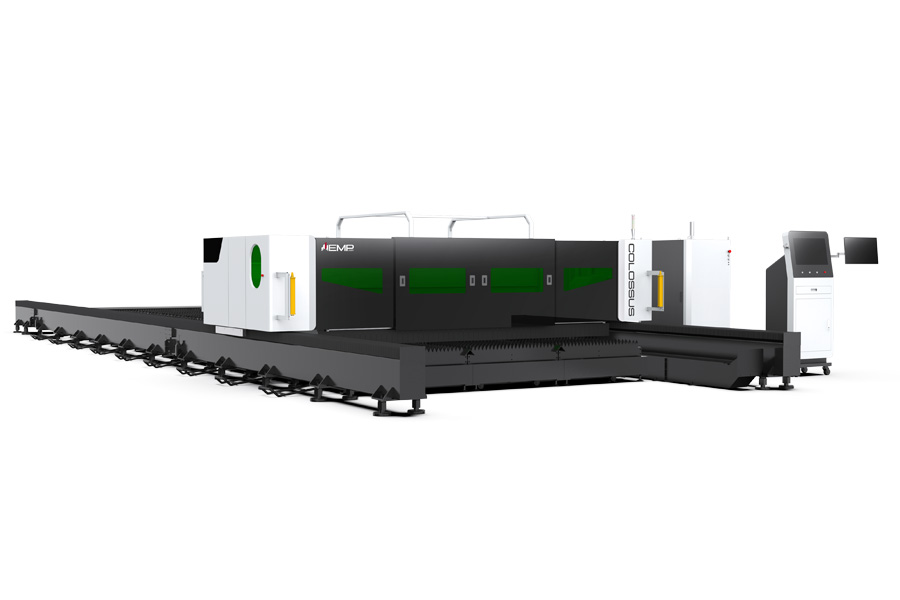
Where beveled edges are required, cutting the bevel on the machine can remove a layout-and-grind operation. It does not remove the need to verify angle, root geometry, and welding procedure requirements. Bevel is also a machine-sizing decision rather than a checkbox — on our Colossus 32, enabling bevel reduces X-axis travel from 127.9 to 98.4 inches and Y from 570.9 to 541.3, while Z increases from 5.9 to 16.519. Size the machine for the configuration you will run.
Galvanizing after fabrication
For assemblies galvanized after fabrication, the cut face becomes part of what enters the kettle under A1239, and the part still has to be designed for venting and drainage under A38510.
Piece Marks, Material Traceability, and Laser Marking
Three records, three jobs
A piece mark tells the erector where a member goes. Grade and material identification supports correct fabrication. Heat-level traceability links a part back to a mill test report. AISC 303 addresses identification through fabrication and erection8, while the project specification and the quality plan set the traceability level — it is not a universal mandate for permanent heat numbers, barcodes, or laser marking.
Keeping material identity through the nest
A nested plate makes the problem concrete. When many parts from one heat come off one plate, something has to connect the incoming material record to the nest, the nest to the cut parts, and the parts to whatever travels with them downstream. That link might be on-table marking, a separate marking station, labels, or controlled staging. The method matters less than the fact that it is documented.
Starting from the record you are required to keep, and then choosing the marking method and software handoff that preserve it, is the order that works. Starting from a marker feature and assuming traceability follows leaves the record dependent on equipment rather than on procedure.
Marking placement
A laser mark alters the surface, so a drawing or quality plan may restrict it on fatigue-sensitive, weld, bearing, or protected-zone locations. We found no universal structural rule making laser marking either always acceptable or always prohibited. The approved documents decide.
What our software does
CypCut handles machine control and CAM on our sheet and plate machines — DXF import, nesting, path optimization, edge finding, autofocus, and cutting parameter management18. Bochu TubePro with TubesT nesting is the tube-side equivalent. Neither package is published as offering MES or heat-lot traceability capability. If your quality plan depends on the cutting software carrying job, batch, or heat records, confirm what the specific configuration does before you build a workflow around it — that is a question worth putting to us directly rather than inferring from a feature list.
Where Laser Cutting Fits — and Where It Doesn't
| Application | Example components | Machine category |
|---|---|---|
| Structural plate parts | Base plates, gusset plates, connection plates, stiffeners, embeds | Ground-rail plate cutters; large-format sheet cutters |
| Sheet metal fabrication | Panels, covers, guards, enclosures, cladding, mounting plates | Sheet cutters |
| Architectural and decorative sheet | Perforated screens, facade panels, soffits, column covers, partitions | Sheet cutters |
| Tube and profile work | Railings, guardrails, handrails, balustrades, frames, canopies | Tube cutters |
| Heavy structural profile | Angle, rectangular section, H-section | Multi-chuck tube cutters |
| Weld preparation | Beveled edges and joint profiles on plate and tube | Plate and tube cutters with bevel configuration |
| Component identification | Piece marks, part numbers, barcodes, QR codes | Fiber, MOPA, and UV markers21 |
Where a laser is not the answer
Rebar
Shear, saw, and flame cutting are the established methods, selected by the splice and end-condition requirement15. We found no evidence supporting fiber laser as a routine economic process for rebar.
High-volume wide-flange processing
Beam drill lines, saws, layout systems, and robotic coping equipment are built around structural members and their recurring operations16. Whether a profile laser complements that equipment or takes work off it depends on member types, profile envelope, feature mix, throughput, and the capital already on the floor.
Light-gauge framing
Studs, track, purlins, and joists are roll-formed sections rather than parts cut from flat stock, and we found no evidence supporting a laser as a substitute for that production process.
High-hole-count architectural panels
Punching can favor repeated standard features at volume. The strongest analysis we located is from 2005 and evaluates CO₂-era equipment, so what it establishes is the set of variables that decide the question — feature repetition, contour complexity, cut length, thickness, and tool changes — rather than a crossover point17. A current fiber-era threshold is not something we found.
Field cutting
These are installed shop systems. Work performed on site is a different toolset.
Non-metal materials
Concrete, masonry, glass, and timber.
If your requirement lands in this block, tell us — the recommendation should follow the requirement, including when it points away from a laser.
Choosing a Laser System for Construction Fabrication
This section has two parts. The first is for shops already running a thermal cutting table. The second is the set of requirements worth pinning down before comparing any two machines, and it applies whether you are replacing equipment or buying your first.
If You're Currently Cutting with Plasma or Oxyfuel
If you already run a plasma table, a burn table, or both, this is a supplement-or-replace decision rather than a first-machine decision, and it is worth framing that way from the start.
What changes is edge condition and kerf width, and where in the process the finishing work sits. On our own comparison, a high-power fiber system can hold tighter tolerances and produce cleaner edges than plasma across many thick-wall applications20 — which moves work out of grinding and fit-up when it applies to your parts. What plasma and oxyfuel still have is lower capital cost and equipment that may already be paid for, and that is a real argument rather than a concession.
There is no single crossover thickness. It depends on material mix, required edge, cycle time, secondary work, and existing capital. Keeping a burn table for heavy or rough work while adding a laser for parts carrying tolerance and edge requirements is a legitimate outcome.
What to Establish Before You Compare Machines
Each of these narrows the field, and format and thickness narrow it fastest. A requirement discovered after a machine is chosen is the expensive kind.
Which formats you process
Plate, sheet, tube, or a mix. This determines machine family before power, automation, or software enters the conversation.
Largest and longest parts
Your largest recurring part and longest recurring section, mapped against bed dimensions and stock length capacity — not the exceptional job that might be better outsourced.
Thickness range
Thickness range against the mix you run most, not the one you run occasionally. Rated maximum and sustained production capability are different figures.
Coatings and surface condition
Galvanized, primed, painted, scaled, or weathered stock, and the extraction that implies.
Edge condition required
The accepted part condition your procedures require, the approved joint detail for welding, and any coating preparation grade your specification invokes. These are separate answers.
Bevel requirements
Whether joint preparation is part of your mix, and at what proportion. Bevel affects machine sizing, not just configuration — on our Colossus 32 it reduces the usable working envelope19.
Marking workflow
On the cutting machine, on a separate marker, or downstream after inspection — and where in the sequence any blasting or coating sits.
Production volume
Whether automation is warranted by the volume you actually run, rather than the volume you are planning for.
Material handling
How plate, sheet, and long stock reach the machine, and the floor space that requires. They load differently.
Documentation
For inspected or certified work: approved drawings, material certificates and identity, procedure records, and inspection records. Raise these before purchase rather than after.
Support
Whether you will need operator and maintenance training, and ongoing technical support.
Requirements reviewed early tend to prevent expensive machine mismatches later. Our tonnage calculator is a starting point for sizing, and our guide to power and process parameters covers speed and thickness by material.
Ready for an assessment?
What we need from you
Work through the checklist above and reach out to our team. The more information you can provide, the better able we will be to make a specific recommendation rather than a general one.
What you can expect from us
Every engagement starts with a consultation covering current workflow, bottlenecks, and production plans — and we will recommend the right equipment whether or not it carries our name.
Built for Production, Backed by Experience
It's easier to enter the world of laser cutting with EMP by your side—even for those new to the technology, we provide expert installation, calibration, and training to ensure your machine is fully operational from day one.

Machine sourcing and configuration

Industrial-Grade Reliability and Quality Control

Custom Production Solutions

Professional Installation

USA-based Technical Support and Training

Flexible Support Contracts
EMP Laser Machines for Construction Metal Fabrication
| Model | Best suited for | Formats and materials | Key specification | |
|---|---|---|---|---|
Colossus 25 / 32 / 40 |
Heavy structural plate, long nests, and work where footprint rather than thickness is the constraint | Flat plate — steel, stainless, aluminum | Widths to 13 ft, lengths extending to 72 ft; series configurable from 6 to 200 kW, with the published Colossus 32 (CL32140) configuration listing 6, 12, 20, 30, and 40 kW at a 10.66 × 47.57 ft working area; optional 45° V/X/Y/K bevel | |
Command 3015 / 4020 / 6020 |
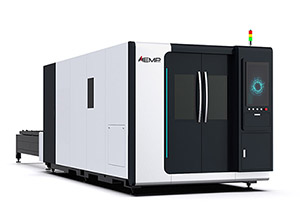
Standard-format plate and sheet at production volume | Flat sheet and plate | 6020 working area 19.85 × 6.67 ft; 6–40 kW; dual-platform exchange table | |
Charger 4020 |
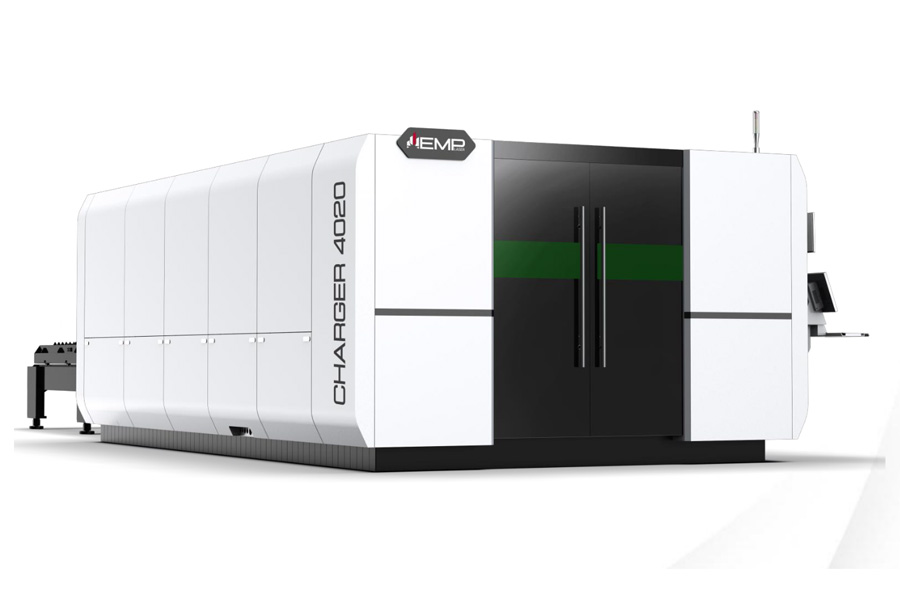
Mid-format sheet and plate where cycle time governs | Flat sheet and plate | 13.3 × 6.7 ft working area; 6–40 kW; 2.8 G, 131.2 in/sec; dual exchange table | |
Cypher 6012 |
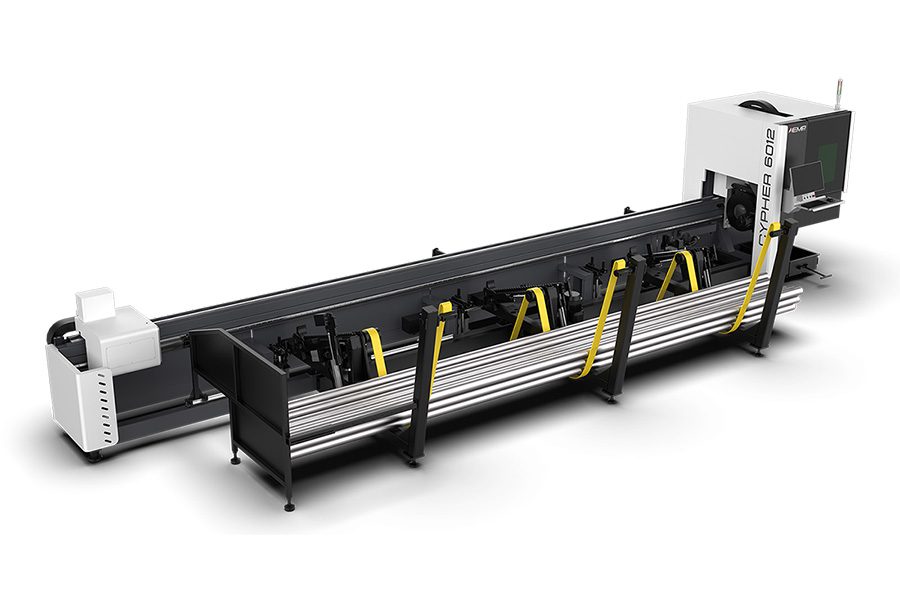
Handrail, guardrail, and small-diameter tube | Round tube 0.4–4.72 in. | Max tube length 21.32 ft; 1.5–3 kW; 200 rpm; 1.18 in. minimum tailing | |
Cyclone 7020 |
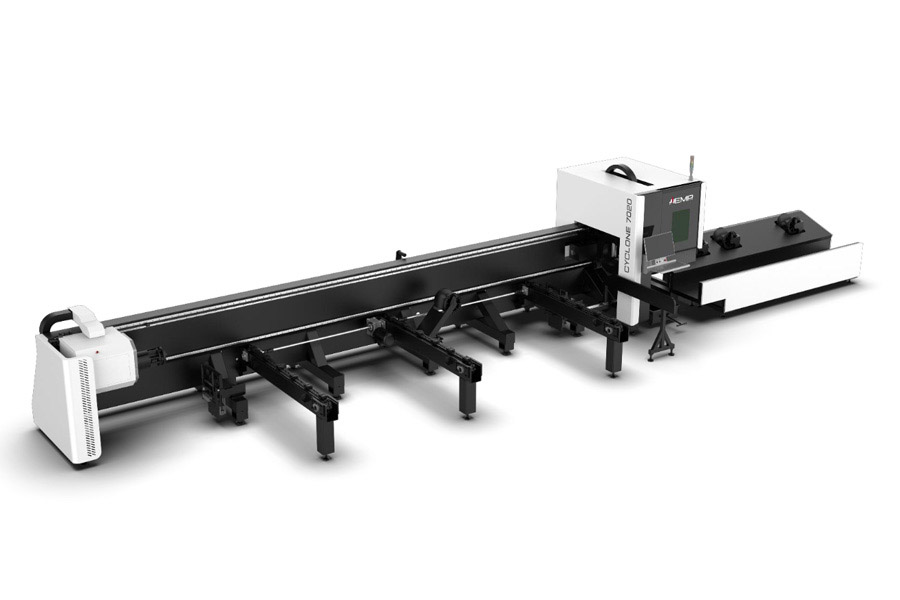
Heavier pipe and profile across a varied mix | Round to 9 in.; profiles | Max tube length 24.6 ft; 1.5–12 kW; 661 lb max chuck load; automatic centering | |
Caliber C2 6026 / 6036 |
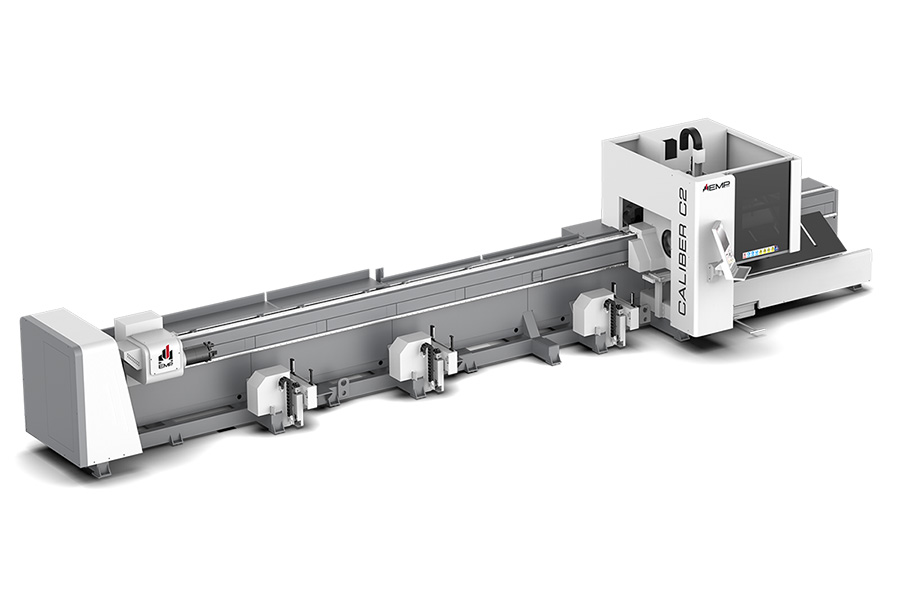
Larger-diameter tube and heavier structural profile | Round, square, rectangular, angle iron, H steel | Max round diameter 9.8 in. (6026) or 13.78 in. (6036); 6–30 kW; max tube length 21.9–40 ft (6026) or 22.3–40 ft (6036); cut lengths 8.2 / 14.7 / 19.6 ft; optional 45° bevel | |
Caliber C3・C4 |
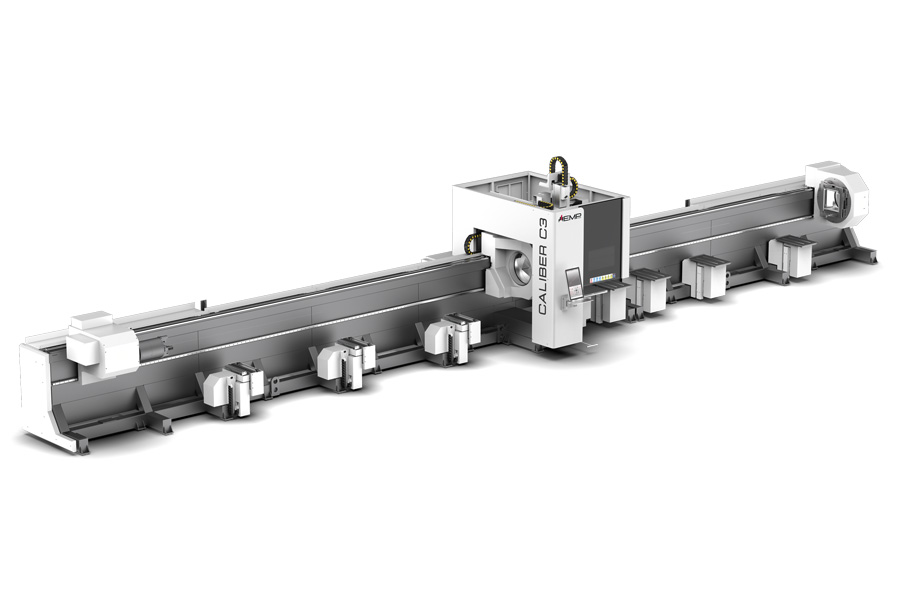
Long structural profile at length | Round, square, rectangular, angle iron, H steel | Configurable 20–50 ft maximum tube length; 6–60 kW; the C4's fourth chuck is specified for zero tailing | |

Fiber, MOPA & UV Markers |
Piece marks, part numbers, and traceability codes | Metals; UV marks selected non-metals | Fiber 30 / 50 W; MOPA 60 / 100 W; UV 5 / 10 / 15 W; Cadenza 30 / 60 / 100 / 200 W |
Specifications are published machine figures rather than achievable finished-part tolerances, and they are model- and configuration-specific — confirm them for the configuration you are quoting. Maximum tube length and maximum cut length are also different measurements: cut length is stock the machine processes end to end, maximum tube length is stock it accepts.
How We Work
From expert planning, delivery and installation to service, training and calibration, EMP Laser provides fast, reliable and professional support.
FAQs
Format decides it first — plate, sheet, tube, or a mix — then your largest recurring part and longest section. Thickness range, surface condition, edge requirements, and volume narrow it from there.
Yes, with the right power configuration, assist gas, and qualified parameters. Rated maximum thickness and a thickness you can run economically in sustained production are different figures, and a rated maximum means little without its material, gas, and quality level. See our plate laser cutting machines page.
Yes, though not as though it were bare steel. The cut leaves an uncoated edge and generates zinc-bearing fume, for which the OSHA permissible exposure limit is 5 mg/m³ as an eight-hour time-weighted average12. Specify extraction against that limit and the coating you are running, and decide up front whether you are repairing edges or galvanizing after fabrication.
Conditionally. The finished edge must meet the workmanship requirements of the AISC edition your project specifies, the AWS requirements for welded work, and your inspection plan3,6. AISC revised the thermally cut surface provision between the 2016 and 2022 editions5, so work from the current text rather than an older summary.
Shear, saw, and flame cutting are the established methods, selected by the splice and end-condition requirement15. We found no evidence supporting fiber laser as a routine economic process for rebar.
Not with the industrial fiber metal cutting systems covered here. They are configured for metal cutting, and those materials need a process qualified for them.
Yes, with nitrogen assist and a configuration suited to reflective material18. Alloy, temper, thickness, and finish all affect the result. On prefinished stock, the finish specification determines whether to cut before or after finishing.
Some configurations can. Our Colossus offers optional bevel cutting to 45° in V, X, Y, and K preparations, and the Caliber tube machines offer optional 45° bevel. On the Colossus 32, enabling bevel reduces the usable working envelope19, so size the machine for the configuration you will actually run.
Not straightforwardly. Beam lines are built around wide-flange members and their recurring operations16. A profile laser may complement one or take work off it, and the boundary depends on member types, profile envelope, feature mix, and throughput.
They are different tools with different economics. On our own comparison, a high-power fiber system can hold tighter tolerances and produce cleaner edges than plasma across many thick-wall applications20; plasma carries a lower capital cost. There is no single crossover thickness — it depends on your material mix, required edge, and existing equipment. Our fiber laser versus plasma cutting article covers it in detail.
Our marking systems produce permanent identifiers on metals21. What preserves heat and lot identity is the digital record and the transfer procedure rather than the marker. Neither CypCut nor Bochu TubePro is published as offering MES or heat-lot traceability capability, so ask us what the specific configuration does before building a workflow around it.
AISC certification applies to the fabricating organization and its quality system2, not to a machine model. What matters is whether the machine supports your documented processes and whether you can produce the records an auditor asks for.
Extraction should be specified against the OSHA permissible exposure limit for zinc oxide fume — 5 mg/m³ over an eight-hour period12 — and against the coating you are actually cutting, rather than against the base metal alone.
Installation and calibration, operator and maintenance training, and tailored service and support contracts, starting from a consultation covering workflow, bottlenecks, and production plans.
Yes, through a third-party lender. See our financing page for current options.
Ready to Get Started?
Our team can help you compare machine configurations, work through material and coating requirements, and choose a laser cutting solution built around your production goals.
Talk to Our Team

Sources
- International Code Council, 2024 International Building Code, Chapter 17, Special Inspections and Tests: https://codes.iccsafe.org/content/IBC2024P1/chapter-17-special-inspections-and-tests — Source-class note: the official chapter page was not fully accessible. The fabricated-items provisions were cross-checked against a secondary code reproduction at https://up.codes/s/special-inspection-of-fabricated-items, which is not the primary text.
- AISC, 207-25 / 420-25 Audit Guide, all programs: https://www.aisc.org/media/taohth35/207-25-420-25-audit-guide-all-programs.pdf — full official text. AISC 207-25 became effective February 1, 2026.
- AISC, ANSI/AISC 360-16, Specification for Structural Steel Buildings and Commentary: https://www.aisc.org/globalassets/aisc/publications/standards/a360-16-spec-and-commentary_june-2018.pdf — full official text of the publicly available edition. Source-class note: 360-16 is not the current edition. It is cited for the structure of the workmanship and AWS-linkage requirements, which the 2022 comparison does not list as changed in that respect. Section M2.2, the thermally cut surface provision, was revised in 2022 — see [5] — so no clause-level or numeric requirement is drawn from this edition.
- AISC, release announcement for ANSI/AISC 360-22: https://www.aisc.org/modernsteel/news/2023/february/aisc-releases-new-version-of-specification-for-structural-steel-buildings-ansiaisc-360-22/ — Source-class note: announcement identifying the current edition. The operative specification text was not accessed.
- AISC, Comparison of ANSI/AISC 360-22 to ANSI/AISC 360-16: https://www.aisc.org/media/myzl4doa/2022-to-2016-spec-comparison.pdf — full official document. Identifies Section M2.2 as revised.
- AWS D1.1/D1.1M:2025-AMD1, Structural Welding Code — Steel, 25th edition with January 2026 amendment: https://www.aws.org/standards-and-publications/codes-and-standards/d1-1/ — Source-class note: official AWS preview and amendment material only, including the contents listing for base metal preparation and reentrant corners. The operative clauses were not accessed. No laser-specific distinction was found in the accessible material, but the full standard was not available.
- AISC, Seismic Provisions for Structural Steel Buildings: https://www.aisc.org/globalassets/aisc/publications/standards/seismic-provisions-for-structural-steel-buildings-ansi-aisc-341-16.pdf — Source-class note: the publicly available full edition is ANSI/AISC 341-16. ANSI/AISC 341-22 is current and its operative text was not accessed. Protected-zone requirements are described qualitatively for that reason.
- AISC, ANSI/AISC 303-22, Code of Standard Practice for Steel Buildings and Bridges: https://www.aisc.org/globalassets/aisc/publications/standards/a303-22w.pdf — Source-class note: officially hosted, but the full text was not retrieved. Identification requirements are described functionally rather than by clause.
- ASTM A123/A123M-24, Zinc (Hot-Dip Galvanized) Coatings on Iron and Steel Products. Source-class note: scope and catalog entry, plus the American Galvanizers Association's summary of the 2024 revision at https://galvanizeit.org/knowledgebase/article/2024-revision-of-astm-a123. The full standard text was not accessed.
- ASTM A385/A385M-22, Providing High-Quality Zinc Coatings (Hot-Dip). Source-class note: scope and catalog entry only; full text not accessed.
- ASTM A780/A780M-20, Repair of Damaged and Uncoated Areas of Hot-Dip Galvanized Coatings: https://store.astm.org/a0780_a0780m-20.html — Source-class note: scope and catalog entry only; full text not accessed.
- OSHA, zinc oxide dust and fume, occupational chemical database: https://www.osha.gov/chemicaldata/215 — full official page. The 5 mg/m³ figure is the OSHA permissible exposure limit. ACGIH threshold limit values are a separate, health-based guideline with different legal standing and are not cited here.
- NIOSH, zinc oxide documentation, PEL88 project: https://www.cdc.gov/niosh/chemicals/pel88/pell-pages/1314-13.html
- Yamane et al., mill scale in oxygen-assisted laser cutting of thick steel plate, Welding International, 2024: https://www.tandfonline.com/doi/full/10.1080/09507116.2023.2275365 — Source-class note: peer-reviewed, oxygen-assisted plate cutting. Addresses mill scale specifically; does not cover rust and does not isolate piercing behavior.
- Concrete Reinforcing Steel Institute, splicing bars: https://www.crsi.org/reinforcing-basics/reinforcing-steel/splicing-bars/ — industry association technical guidance.
- AISC, Evolution of Structural Steel Fabrication, Modern Steel Construction, February 2012: https://www.aisc.org/globalassets/modern-steel/archives/2012/02/2012v02_evolution_of_fab.pdf — Source-class note: describes beam-line and robotic coping processes. Does not establish an economic substitution boundary against profile lasers.
- Wang and Xie, process planning for combined punch and laser machining, 2005: https://www.sfu.ca/~gwa5/pdf/2005_03.pdf — Source-class note: peer-reviewed but CO₂-era. Establishes the decision variables; does not establish a current fiber-laser crossover threshold.
- EMP Laser, fiber laser cutting process parameters: https://emplaser.com/fiber-laser-cutting-process-parameters — Source-class note: our own technical page. Authoritative for EMP machine and software specifications; for general assist-gas and edge-chemistry guidance it is manufacturer content rather than independent literature.
- EMP Laser, Colossus ground-rail fiber laser plate cutter: https://emplaser.com/emp-colossus-ground-rail-fiber-laser-plate-cutter — our own product page. Bevel travel figures are published under the Colossus 32 (CL32140) table and apply to that configuration.
- EMP Laser, plasma versus laser tube cutting: https://emplaser.com/plasma-vs-laser-tube-cutting-machine — Source-class note: our own comparison page rather than independent testing, and its claim is qualified — high-power laser systems "can process many thick-wall applications while maintaining tighter tolerances, cleaner edges." That modality is preserved above.
- EMP Laser, fiber laser marking machines: https://emplaser.com/fiber-laser-marking-machine — our own product page.
- EMP Laser, financing: https://emplaser.com/financing — our own page. Financing is provided through an outside lender, with the third-party disclaimer carried there.