
What Makes Marine Fabrication Different
Cutting errors get expensive at the fit-up bench
A vessel is an assembly of assemblies, and every dimensional error in a cut part reappears at fit-up as grinding, shimming, or rework — which costs far more there than it did at the cutting machine. This is why repeatability across a run matters more than a single impressive tolerance number, and why machine positioning and repeatability figures, which describe axis motion under test, should never be read as the tolerance a finished part will hold. Material, thickness, fixturing, and thermal condition all sit between the two.
Cutting heat drives distortion you pay for later
A laser concentrates heat into a narrower zone than plasma or oxyfuel and can reduce total thermal loading22,23. How much distortion that saves on a given plate is not something published data can answer — the comparative studies on primed or scaled marine stock, at matched thickness and restraint, were not accessible from trusted sources. Treat the reduction as directional and measure it on your own material.
The material list is longer and stranger than structural steel
Hull grades under ABS classification, marine aluminum plate and extrusion, copper-nickel piping, stainless in outfitting. Each behaves differently under a laser, and two carry constraints that have nothing to do with whether the machine can cut them.
Material arrives in real-world condition
Hot-rolled plate carries mill scale. Where a yard runs a prefabrication priming line, plate arrives coated. Most published cutting data assumes clean, uncoated stock, and that gap matters more here than the data usually admits.
Class, survey, and coating
Commercial marine construction sits inside a framework where IACS coordinates minimum technical requirements and individual societies apply their own rules and survey systems12, while for US-flag vessels the Coast Guard authorizes recognized societies to perform specified statutory functions rather than replacing the flag-state framework13. Approval attaches to designs, materials and manufacturers, welding procedures, welders, and surveyed work — in defined scopes8,9. It does not attach automatically to a cutting machine, and it is not a single blanket credential a shop holds.
Shop versus vessel
The systems described in this article are fixed shop equipment. Work performed on a vessel — afloat, alongside, or in dry dock — is outside what they do.
Marine Metals, Coatings, and Surface Condition
Three things determine how a marine material cuts: the specific alloy, the surface condition it arrives in, and what the downstream procedure requires of the edge. Knowing the metal family — steel, stainless, aluminum, copper, nickel, etc — is where that answer starts rather than where it ends.
Alloy is only half the question. Surface condition and coating are the other half, and marine stock varies on both.
| Material | Marine use | Cutting considerations | Assist gas |
|---|---|---|---|
| Hull steels — ABS grades A/B/D/E, AH/DH/EH | Hull, deck, bulkhead, structural members; grade depends on thickness and location6 | We found no source showing grade alone predicts edge quality. Condition, thickness, and power matter more | Oxygen or nitrogen by edge requirement; we found no marine-grade-specific rule |
| Shop-primed and mill-scaled steel | Plate through a prefabrication priming line | Coating and scale change conditions at the pierce; we found no published data on real primer systems | Trial on your material |
| 5xxx aluminum plate — 5083, 5086, 5456 | Hull and superstructure on aluminum craft4,19 | Feasible; we found no marine study quantifying alloy and temper effects | Nitrogen or air by oxidation tolerance |
| 6061 and 6082 extrusions | Structural sections, frames, stiffeners19; 6082 sections appear in published small-craft schedules10,11 | Stock shape, support, and clamping matter as much as cuttability | No alloy-specific figure found |
| Copper-nickel — C70600, C71500 | Seawater, bilge, ballast, firefighting systems14,15 | Accepted method; we found no published production envelope — see below | Not established |
| Stainless steel | Outfitting, handrails, sanitary systems, fittings | ABS requires smooth cuts, notch and gouge limits, oxide removal, iron-free tools5 | By oxidation tolerance and downstream procedure |
Copper-nickel
Laser cutting is an accepted method.
The Copper Development Association and the Nickel Institute independently state that copper-nickels can be laser and abrasive waterjet cut, and that oxy-acetylene cutting is not appropriate for solid copper-nickel14,15. That second part is the surprising half — the process a shop would traditionally reach for is the one ruled out. One exception: for clad plate at a steel-to-clad ratio of at least 4:1, oxy-acetylene is acceptable14.
Establishing your cutting parameters takes a trial.
The published guidance confirms the method but stops short of a production envelope — no power, wall thickness, speed, assist gas, or quality class is specified for C70600 or C71500. Pure-copper parameter charts are the wrong substitute, because the nickel content changes both the optical and thermal behavior. Two practical routes: ask your machine builder and alloy supplier for trial data, which is often held privately rather than published, and run samples at your actual wall thickness and geometry. That combination gives you numbers you can plan production around.
Why copper alloys are demanding, and what changed.
Solid copper absorbs only around 5% of incident energy near 1,070 nm at room temperature20, so the pierce is the demanding stage rather than the cut — a flat, cool surface returns most of the beam and conducts heat away. Once a molten cut front develops, coupling improves substantially. The risk is returned energy destabilizing or damaging the source. Modern sources address this in the source architecture rather than by shutting down: some designs convert returned optical power to heat and dissipate it17, others use multi-stage back-reflection immunity18. That is why "copper cannot be cut on a fiber laser" is no longer accurate. It is also why "fiber laser" alone tells you nothing — protection is a source and head specification, not a property of the technology. Confirm it for the configuration you are quoting.
This is also where copper-nickel parts company with pure copper. Alloying with nickel lowers thermal conductivity substantially 14,15, so heat stays local to the cut front instead of draining away into the surrounding material. That works in your favor on both the pierce and the cut. How far it shifts your power and speed settings is what the trial establishes.
Nickel
Nickel content should lower thermal conductivity in a direction that makes copper-nickel less demanding than pure copper, but we have not found that measured at 1,070 nm for either alloy. We will describe the direction and not claim a magnitude.
Aluminum
Marine aluminum carries a constraint that catches fabricators coming from other industries, covered in the next section because it is a class requirement rather than a cutting property. On the 5xxx sensitization question, which comes up often: that is a time-at-temperature and service-corrosion issue, and we found no evidence that a fast cutting heat-affected zone is equivalent to prolonged sensitizing exposure.
Shop primer and mill scale
Where prefabrication priming is used on vessels covered by the IMO protective coating standard, the specified baseline is a zinc-containing, inhibitor-free zinc silicate or equivalent1. Outside those covered spaces, primer specification is a yard and owner decision, and we did not find a general industry baseline.
Two things follow where zinc-bearing primer is present. Thermal processing can generate zinc oxide fume, for which the OSHA permissible exposure limit is 5 mg/m³ as an eight-hour time-weighted average, with metal fume fever as the acute syndrome16. And the cut edge is bare steel afterward — the coating does not survive the cut, and the downstream coating system governs how the edge is prepared.
What we are not able to give you is a general figure for how a given primer thickness, age, and chemistry affects pierce reliability, dross, or cut speed. We did not find a comparative study of clean, scaled, and primed marine plate on modern fiber equipment in the accessible published literature, and the same applies to mill scale. Machine builders and coating suppliers may hold proprietary trial data we have not seen, and it is worth asking. What we would say either way is that these are material-specific enough that a figure from someone else's stock is a starting point rather than an answer — the number that governs your production is the one from a trial on your plate, in the condition it arrives.
What a fiber laser does not process
This is metal-cutting equipment. GRP and composite hulls, timber, glass, and most plastics fall outside it entirely, and a process qualified for the material is required instead. UV markers can mark selected non-metals; that is marking, not cutting.
Titanium and super duplex stainless appear in marine and offshore corrosion service, but not at a frequency that puts them alongside the materials above for this work. If they are in your mix, that is a conversation to have with us directly.
Cut Edges, Coating Standards, and What Class Requires
A laser edge removes secondary processing in some places and not others, and for marine work the distinction is specific enough to plan around.
What a laser-cut edge consists of
A laser-cut edge is the cut face, a recast layer, a narrow heat-affected zone, and whatever dross remains, varying by material, thickness, and assist gas. A laser's heat-affected zone is narrower than that of oxyfuel or plasma cutting22,23. A narrow heat-affected zone is not the same as satisfying a requirement, and the requirements below are written against edge condition, not against how the edge was produced.
Aluminum carries a burden of proof, not a dimension
ABS rules permit plasma and other thermal cutting methods for aluminum only where the shipyard demonstrates to the surveyor that there is no deleterious effect on the base material or the completed weld, with edge preparation accurate and uniform to the approved joint detail4. For an aluminum workboat builder that changes where acceptance comes from: it is demonstrated on your material, to your surveyor, for your procedure. A machine cannot carry that for you — but controlled, repeatable parameters are what make the demonstration straightforward.
Stainless carries specific requirements
ABS requires cutting equipment to produce smooth cuts, limits notches and gouges, requires oxide removal, and requires iron-free tools for grinding and brushing5. The iron-free tooling requirement catches shops running carbon and stainless through the same finishing area.
Coating standards grade the edge separately from the cut
ISO 8501-3 sets three preparation grades for welds, cut edges, and other visible imperfections before coating, designated P1, P2, and P32. Grade P1 is light preparation — slag and loose scale removed. Grade P2 is thorough preparation, which addresses an irregular edge profile. Grade P3 is very thorough, removing the cut face and rounding the edge. The exact wording of each grade is edition-specific, so check the edition your coating specification invokes.
Thermal cut quality has its own classification, and it covers laser
ISO 9013 classifies geometrical quality for flame, plasma, and laser cutting, with laser applicability from 0.020 to 1.26 inches (0.5–32 mm)3. When a customer's fabrication drawing or purchase specification calls for a thermal cut quality class, this is the standard most likely behind that requirement. We found no primary rule text making it a general marine mandate, so it applies where a contract or specification invokes it.
When work moves into PSPC-covered vessels
Some marine work falls under the IMO Performance Standard for Protective Coatings, usually shortened to PSPC and published as Resolution MSC.215(82). It is a coating standard: it sets how protective coatings are specified, applied, and inspected in the spaces most exposed to seawater corrosion, and a vessel is "PSPC-covered" when its construction falls inside the standard's scope. That scope is narrow. It applies to dedicated seawater ballast tanks on ships of at least 500 gross tonnage and double-side skin spaces on bulk carriers of at least 150 meters, subject to the resolution's construction-date triggers — so it reaches new construction contracted, keel-laid, or delivered after specified dates rather than the whole existing fleet1. For US-flag vessels it takes effect through SOLAS and the flag-state and class framework described above rather than as a standalone US regulation; whether it reaches a given hull is a question for the owner's specification and the attending society.
Where it does apply, the requirement is specific. Sharp edges must be removed, and edges must receive at least a 2 mm rounded radius, three-pass grinding, or an at-least-equivalent process before painting1.
A clean, sharp laser edge does not by itself satisfy that. It is a coating-performance requirement — paint film thins over a sharp edge regardless of how smooth the cut is — and it is not waived by cut quality. Where PSPC applies, the edge still needs treatment.
One precision worth carrying, because it is commonly stated wrong: the resolution references ISO 8501-3 grade P2 and separately requires the 2 mm rounding. Both apply; meeting the P2 grade does not satisfy the rounding requirement, and rounding an edge does not satisfy P21,2. The resolution normatively cites the 2001 edition of ISO 8501-3, even though 2025 is now the current standalone edition.
Which edges go straight to the next operation
An edge leaves the cutter ready for welding only when it meets the approved joint detail and welding procedure, including any required oxide, recast, or dross treatment. Where the joint detail is satisfied, a laser removes a preparation step — and a beveled edge can remove a separate weld-prep operation where the geometry matches the procedure. Where a coating specification invokes a preparation grade, or where PSPC applies, the edge goes to a finishing operation regardless of how it was cut. Bevel capability does not satisfy coating-edge rounding; they are different requirements answering to different documents.
Part Marking, Material Identity, and Laser Marking
Marine construction survey guidance explicitly covers traceability and acceptability of plate and profile material, material type, scantling identification, and test marks through surface preparation, marking, and cutting9. Material identity has to survive nesting and cutting, and a nested plate carrying many parts from one heat needs controlled staging and a nest-to-heat record to keep it.
A laser marker can carry identifiers, part numbers, barcodes, and Data Matrix codes either before or after cutting
What preserves heat and lot identity is the digital record and the physical transfer procedure, not the marker. We should be clear about what our software does: CypCut handles machine control and CAM — DXF import, nesting, path optimization, edge finding, autofocus, and cutting parameter management21. Bochu TubePro with TubesT nesting is the tube-side equivalent; capability descriptions vary by machine, so check the specific product page for the model you are considering21. Neither package is published as offering MES or heat-lot traceability, so your material identity system has to sit outside the cutting software.
The survivability question is the one to settle before committing to a sequence.
If plate is blast-cleaned and coated after cutting, whether a laser mark survives depends on mark depth, blast media, pressure and angle, and the coating system. We could not find an authoritative survival test, and we are not going to promise it. If marking sits upstream of blasting in your process, validate it on your material and your blast parameters before it becomes production. Yards use paint, chalk, ink, tags, stamped marks where permitted, and re-marking after coating; which of those is right depends on where the identifier has to survive to.
Where Laser Cutting Fits — and Where It Doesn't
| Application | Example components | Machine category |
|---|---|---|
| Flat structural plate | Bulkhead panels, deck plating, floors, girder and floor webs, brackets, foundations | Large-format sheet cutters; ground-rail plate cutters where footprint or nest length governs |
| Sheet fabrication | Covers, guards, enclosures, joiner panels, mounting plates | Sheet cutters |
| Small-bore pipe and tube | Instrumentation tubing, small hydraulic and service lines | Small-diameter tube cutters |
| Pipe and profile | Spools, hangers, supports, penetrations, ventilation profiles | Heavy-duty tube cutters |
| Long structural profile | Angle, channel, rectangular section, H-section for fabricated assemblies | Multi-chuck tube cutters |
| Weld preparation | Beveled edges and joint profiles on plate and tube | Plate and tube cutters with bevel configuration |
| Component identification | Part numbers, barcodes, Data Matrix codes | Fiber, MOPA, and UV markers |
Scantlings
Scantlings are the required dimensions of a vessel's structural members — the plate thicknesses and section sizes classification rules call for. For smaller commercial vessels, those rules put most plate in the millimeter range rather than the inch range6,7. At those thicknesses, penetration is rarely what limits the machine. Plate footprint, material handling, nest length, and throughput usually decide it instead. Heavier stock does appear in some vessel classes, and there thickness governs — so the figure worth checking first is not a machine's headline thickness rating, but which of these constraints your own work actually runs into.
Material Thickness
Thickness still governs where a vessel class calls for heavier stock. What we would push back on is choosing a machine on a headline thickness figure without first checking whether thickness is the constraint your work actually runs into.
Where a laser is not the answer
Formed shell plating
Shell plate is formed by rolling, pressing, and line heating24. A flat-bed laser processes flat stock, and once plate is formed, the access, datum, and support geometry change. Cut flat, then form, is the preferred sequence for new components — it does not cover later trimming or repair cutouts, and it is not a statement about 3D or robotic laser processes, which are different equipment.
Heavy plate where the economics change
There is no universal thickness at which a laser stops making sense against plasma or oxyfuel. It depends on material, required quality, source power, gas consumption, pierce count, utilization, capital already sunk, and downstream labor. A crossover number is only as good as the cost model behind it, so it is worth asking what went into any figure you are given.
Large yard panel lines
A panel line integrates plate flow, joining, cutting and marking, stiffener fitting, and welding as a linked system. A discrete flat-bed machine does not replace that line's handling, joining, and stiffener stages, though it can serve a separate component cell alongside it.
Pipe beyond the machine's geometry
Marine systems size piping by formula and by system rather than to one nominal diameter, so there is no single ceiling we can quote. What matters is your actual outside diameter, wall thickness, stock length, and unit mass against a specific machine's published envelope. Above it, sawing and other processes handle the work.
Work on the vessel
The systems here are fixed shop equipment. Cutting performed afloat, alongside, or in dry dock is a different toolset.
Non-metal hulls and structures
GRP, composite, and timber.
If your requirement lands in this block, tell us — the recommendation should follow the requirement, including when it points away from a laser.
Choosing a Laser System for Marine Fabrication
This section has two parts. The first is for shops already running a thermal cutting table, which is where most of this evaluation starts. The second is the set of requirements worth pinning down before you compare any two machines, and it applies whether you are replacing equipment or buying your first.
If You're Currently Cutting with Plasma or Oxyfuel
If you already run a plasma table, a burn table, or both, this is a supplement-or-replace decision rather than a first-machine decision, and it is worth framing that way from the start.
What changes is edge condition and kerf width, and where in your process the finishing work sits. What plasma and oxyfuel still have is lower capital cost and equipment already paid for, and that is a real argument rather than a concession. Keeping a burn table for heavy or rough work while adding a laser for parts carrying tolerance and edge requirements is a legitimate outcome — and for a shop with an established burn table, it is often the cheaper answer.
What to Establish Before You Compare Machines
Each of these narrows the field, and format and thickness narrow it fastest. Work through them before you start comparing specifications — a requirement discovered after a machine is chosen is the expensive kind.
Which formats you process
Plate, sheet, tube, or a mix. This determines machine family before anything else.
Largest and longest parts
Largest actual part and longest section mapped against bed dimensions and stock length capacity.
Thickness range
Thickness range against the mix you run most, not the one you run occasionally.
Surface conditions
Surface condition and coating and the extraction that implies.
Alloys in the mix
Copper-bearing alloys require confirmed source and head back-reflection protection and representative trials. Do not infer protection from the word "fiber."
Edge condition required
Edge condition your procedures require, the approved joint detail for welding, and the preparation grade your coating specification invokes. These are separate answers.
Bevel requirements
Bevel is a sizing decision rather than a checkbox: on our Colossus, enabling bevel reduces the usable working envelope21, so the machine has to be sized for the bevel configuration rather than the straight-cut one.
Marking workflow
On the cutting machine, on a separate marker, or downstream, and where in the sequence blasting sits.
Material handling
How plate and long stock reach the machine, and the floor space that requires.
Documentation
Approved drawings, material certificates and identity, welding procedure records, and inspection records.
Support
Will you need to train operators and maintenance staff? Will you need ongoing technical support?
Requirements reviewed early tend to prevent expensive machine mismatches later.
Ready for an assessment?
What we need from you
Go through the checklist above and reach out to our team. The more information you can provide, the more better able we will be to make a specific recommendation rather than a general one.
What you can expect from us
Every engagement starts with a consultation covering current workflow, bottlenecks, and production plans — and we will recommend the right equipment whether or not it carries our name.
Built for Production, Backed by Experience
It's easier to enter the world of laser tube cutting with EMP by your side—even for those new to the technology, we provide expert installation, calibration, and training to ensure your machine is fully operational from day one.

Machine sourcing and configuration

Industrial-Grade Reliability and Quality Control

Custom Production Solutions

Professional Installation

USA-based Technical Support and Training

Flexible Support Contracts
EMP Laser Machines for Marine Fabrication
| Model | Best suited for | Formats and materials | Key specification | |
|---|---|---|---|---|
 Colossus 25 / 32 / 40
|
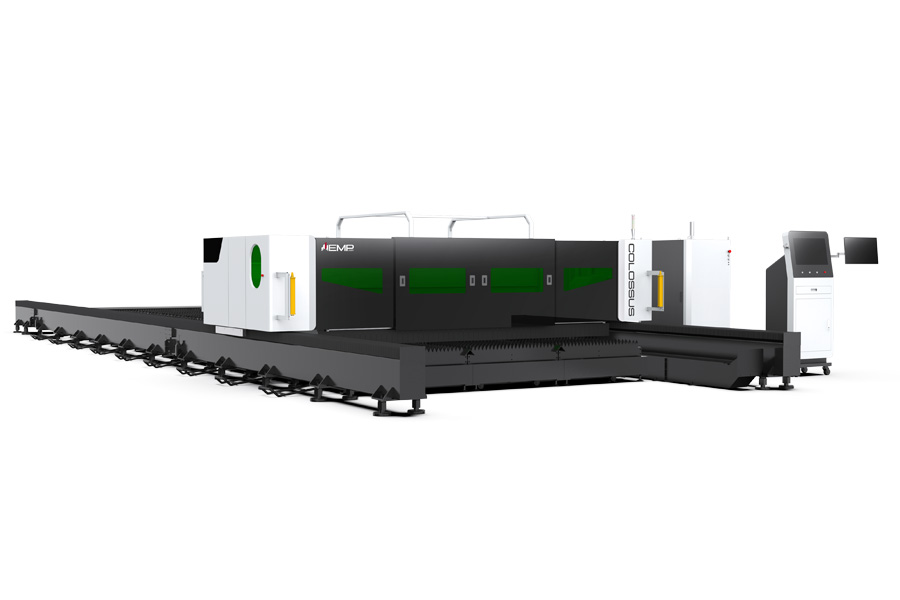
Oversized plate, long nests, and work where footprint rather than thickness is the constraint | Flat plate — steel, stainless, aluminum | Widths to 13 ft, lengths extending to 72 ft; published configuration CL32140 at 10.66 × 47.57 ft; 6–200 kW range; optional 45° V/X/Y/K bevel | |
 Command 3015 / 4020 / 6020
|
Standard-format plate and sheet at production volume | Flat sheet and plate | 6020 working area 19.85 × 6.67 ft; 6–40 kW; dual-platform exchange table | |
 Charger 4020
|
Mid-format sheet and plate where cycle time governs | Flat sheet and plate | 13.3 × 6.7 ft working area; 6–40 kW; 2.8 G, 131.2 in/sec; dual exchange table | |
 Cypher 6012
|
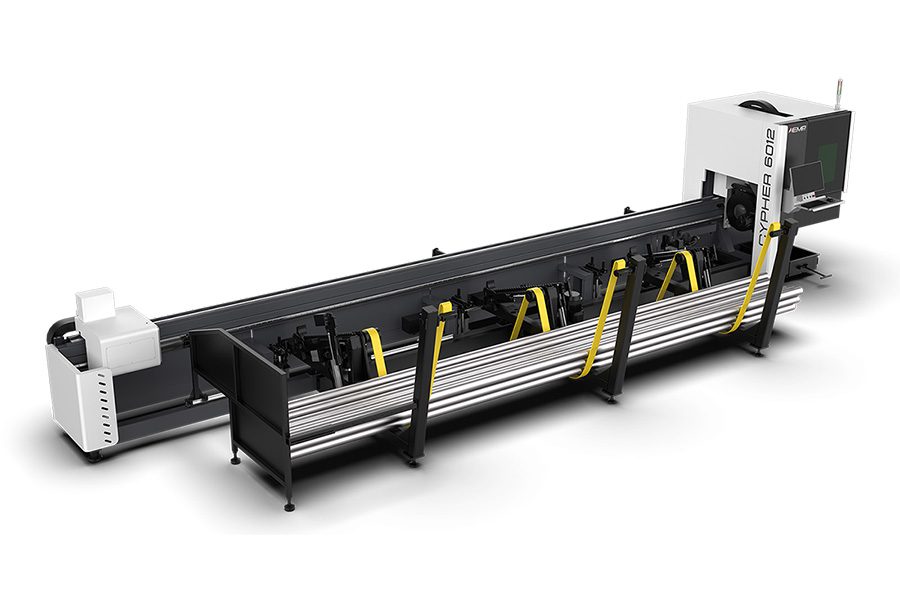
Small-bore tube and instrumentation lines | Round tube 0.4–4.72 in. | Max tube length 21.32 ft; 200 rpm; 1.18 in. minimum tailing | |
Cyclone 7020 |
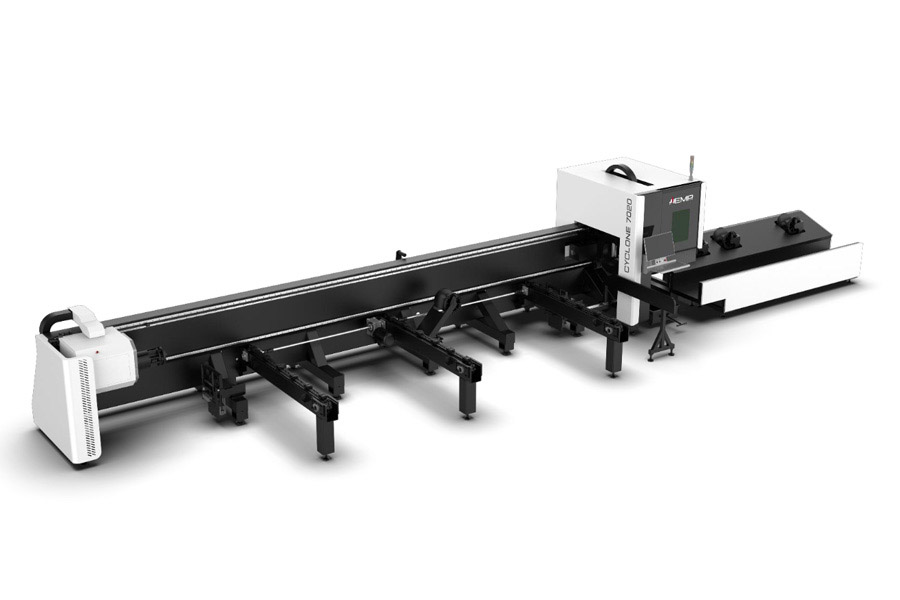
Pipe and profile across a varied mix | Round to 9 in.; profiles | Max tube length 24.6 ft; 1.5–12 kW; 661 lb chuck load; automatic centering | |
Caliber C2 6026 / 6036 |
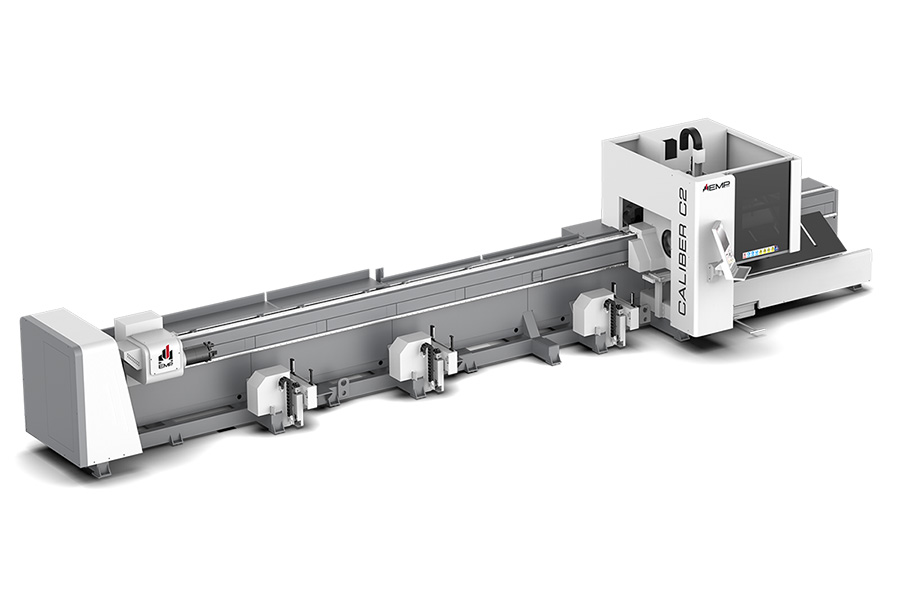
Larger-diameter pipe and heavier profile | Round, square, rectangular, angle, H-section | Round to 9.8 in. (6026) or 13.78 in. (6036); 6–30 kW; max tube length to 40 ft; optional 45° bevel | |
Caliber C3・C4 |
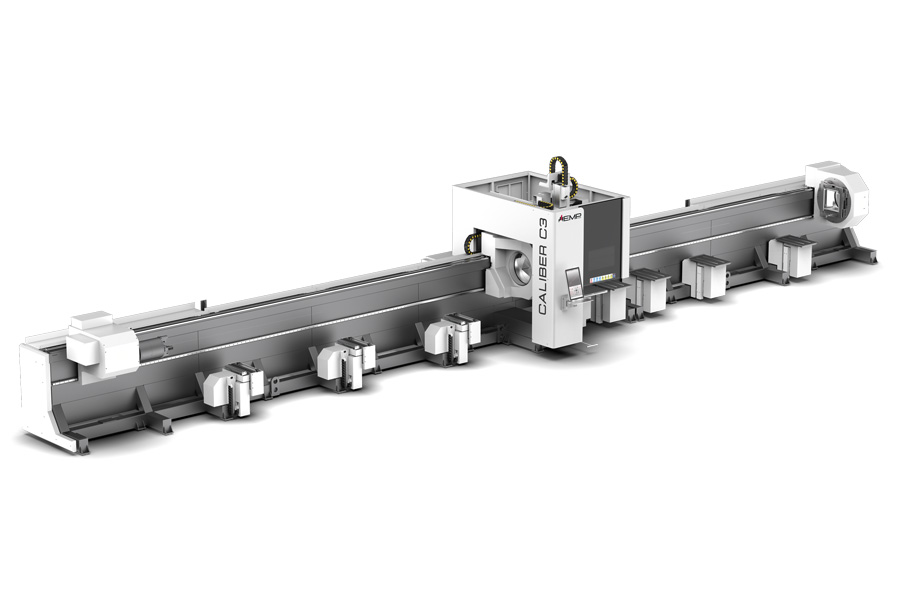
Long structural profile at length | Round, square, rectangular, angle iron, H steel | Configurable 20–50 ft maximum tube length; 6–60 kW; C4 adds a fourth chuck for zero tailing | |

Fiber, MOPA & UV Markers |
Part identification and traceability codes | Metals; UV marks selected non-metals | Fiber 30/50 W; MOPA 60/100 W; UV 5/10/15 W; Cadenza 30–200 W |
Maximum tube length and maximum cut length are different measurements. Cut length is stock the machine processes end to end; maximum tube length is stock it accepts. Confirm which figure your application needs.
How We Work
From expert planning, delivery and installation to service, training and calibration, EMP Laser provides fast, reliable and professional support.
FAQs
Format decides it first — plate, sheet, tube, or a mix — then your largest actual part and longest section. For work at the smaller-vessel end of the market, plate footprint and handling are likely to decide the machine before thickness does.
Yes. Classification rules for smaller commercial vessels set scantlings comfortably inside fiber capability6,7. Rated maximum and sustained production thickness are different figures, and a rated maximum means nothing without its material, gas, and quality level. See our plate laser cutting machines page.
Laser cutting is an accepted method, and oxy-acetylene is not appropriate for solid copper-nickel14,15. We did not find a published power, wall thickness, or assist gas envelope for C70600 or C71500, so a production answer requires trials. The configured source and head must carry back-reflection protection — a specification, not a property of fiber lasers generally.
Yes, across the 5xxx plate and 6xxx extrusion alloys used in marine construction19. We found no marine study quantifying alloy and temper effects on edge quality, so parameters are established on your material. Note the ABS acceptance requirement above.
The primer changes conditions at the pierce, and the cut edge is bare steel afterward regardless. Where zinc-bearing primer is present, thermal processing can generate zinc oxide fume, for which the OSHA limit is 5 mg/m³ TWA16. We did not find published data on behavior with real marine primer systems — it is a trial question.
Conditionally. For welding, the edge must meet the approved joint detail. For aluminum, ABS requires the shipyard to demonstrate no deleterious effect to the surveyor4. For coating, the applicable ISO 8501-3 grade governs2 — and in PSPC-covered spaces, edges require a 2 mm radius, three-pass grinding, or equivalent regardless of cut quality1.
We identified no general class or type approval for laser cutting equipment8,9. Approval attaches to designs, materials and manufacturers, welding procedures, welders, and surveyed work in defined scopes. If a machine is described as a class-certified machine, ask which society, what scope, and for the certificate.
Not on a flat bed. Shell plate is formed by rolling, pressing, and line heating24, and once formed the access and support geometry change. Cut flat, then form, is the preferred sequence for new components.
Not with the industrial fiber metal cutting systems covered here. They are configured for metal cutting; GRP, composite, and timber need a process qualified for them.
Our Colossus is a modular ground-rail system with widths to 13 feet and lengths extending to 72 feet; the published CL32140 configuration has a 10.66 × 47.57 ft working area. Those are different levels of claim — a modular ceiling and a specific configuration — worth keeping distinct when comparing quotes.
On our Colossus, yes. Bevel reduces X-axis travel from 127.9 to 98.4 inches and Y from 570.9 to 541.3, while Z increases from 5.9 to 16.5. Size the machine for the configuration you will run.
Installation and calibration, operator and maintenance training, and tailored service and support contracts, starting from a consultation covering workflow, bottlenecks, and production plans.
Yes, through a third-party provider. See our financing page for current options.
Ready to Get Started?
Our team can help you compare machine configurations, understand material capabilities and choose a laser cutting solution built around your production goals.
Talk to Our Team

Sources
- IMO, Resolution MSC.215(82), Performance Standard for Protective Coatings for Dedicated Seawater Ballast Tanks and Double-Side Skin Spaces of Bulk Carriers, adopted December 8, 2006. Full official text.
- ISO 8501-3, Preparation grades of welds, cut edges and other areas with surface imperfections. 2025 current edition; 2001 edition normatively cited by MSC.215(82). Source-class note: the 2025 full text was not accessed — catalog entry and preview only. Grade descriptions in general circulation trace to earlier editions.
- ISO 9013:2017, Thermal cutting — Classification of thermal cuts. Source-class note: official ISO/TC 44 summary; full class tables not accessed.
- ABS, Rules for Materials and Welding — Aluminum and Fiber Reinforced Plastics, Part 2, 2013. Full official archived text.
- ABS, Requirements for Materials and Welding for Stainless Steels, July 2022. Full official text.
- ABS, Rules for Building and Classing Steel Vessels Under 90 Meters in Length, Part 3, July 2019. Full official archived text. Scantling values are rule minima, not observed typical practice.
- ABS, Rules for Building and Classing Steel Vessels for Service on Rivers and Intracoastal Waterways, 2025. Same note as [6].
- ABS, Guide for Shipbuilding and Repair Quality Standard for Hull Structures, 2007. Archived.
- ABS, Hull Survey for New Construction survey guidance.
- UK Maritime and Coastguard Agency, Construction and Outfit Standards — Steel and Aluminium Construction, MGN 628 Part 4, Rev. 07.20. Source-class note: UK regulator's scantling schedules for small fishing vessels specifically. Cited here only for the presence of 6082 sections in small-craft construction. Not a US requirement and not evidence about commercial workboats generally.
- UK Maritime and Coastguard Agency, MGN 629 Part 4, Rev. 07.20, 15–24 m registered length. Same source-class note as [10]. Retained as corroboration only.
- IACS, Role of Class.
- US Coast Guard, Classification Society Authorization, Flag State Control Division.
- Copper Development Association, copper-nickel welding and fabrication guidance.
- Nickel Institute, Copper-Nickel Welding and Fabrication, 3rd edition, 2018.
- NIOSH, Pocket Guide to Chemical Hazards, zinc oxide entry, and OSHA PEL history.
- nLIGHT, back-reflection protection technical documentation. Source-class note: laser source manufacturer documentation. Describes conversion of returned optical power to heat.
- Coherent, HighLight FL fiber source documentation. Source-class note: laser source manufacturer documentation. Describes multi-stage back-reflection immunity, which is not the same mechanism as [17].
- The Aluminum Association, International Alloy Designations and Chemical Composition Limits for Wrought Aluminum and Wrought Aluminum Alloys.
- Peer-reviewed copper laser-processing and temperature-dependent reflectance studies. Source-class note: laser powder bed fusion and optical measurement studies, not sheet cutting. Mechanism transfers; cutting magnitudes do not.
- TWI, heat-affected zone technical guidance.
- Comparative heat-affected zone study, thermal cutting processes. Source-class note: establishes relative HAZ width by process; does not establish a distortion outcome on marine stock.
- Published study on line heating in ship hull plate forming.