
What Makes Oil & Gas Fabrication Different
Three kinds of pipe work, three different jobs
Round material in an oil and gas shop can be doing one of three jobs, and each answers to something different. Process piping — the piping inside refineries, processing plants, and terminals — is fabricated to ASME B31.34. Line pipe is manufactured to API 5L, which specifies how seamless and welded steel pipe for pipeline transportation systems is made5. Cutting line pipe into an assembly is fabrication, not manufacture, and it answers to the code and specification for the assembly being built. Structural tube and hollow structural sections (HSS) in skid frames and pipe racks are structure, and are governed as structure.
Pressure duty changes what an edge is for
On a pressure-retaining part, a cut edge may become one side of a weld joint or the boundary of an opening in a pressure boundary. That gives it a code requirement as well as a dimensional one, and the governing codes do not all say the same thing about it.
The materials go past carbon steel
Stainless, chrome-moly, duplex, and carbon steel held to sour-service hardness limits each raise their own questions about the cut edge. The alloy you run shapes the edge you are allowed to leave, not only the parameters you cut it with.
Material identity has to survive fabrication
Mill test reports (MTRs) and heat numbers tie material to its certified properties. When a nest divides one plate into many parts, that link has to be carried deliberately, and keeping it through cutting is sometimes a code requirement and sometimes a purchaser's.
A skid is an assembly, not a code category
A skid carries structural steel, piping, and sometimes pressure vessels on one frame. We did not find a single code that governs a skid as a whole; the IOGP/JIP33 specification for deluge skids, for example, calls on component codes and specifications for each part rather than replacing them6. The purchaser's specification ties those requirements together.
Shop versus field
The systems described in this article are fixed shop equipment. Pipeline tie-ins, hot taps — connections made to pipe that is in service — and modifications to installed pipework are a different toolset.
Pressure Duty, Fabrication Codes, and What the Cut Edge Must Satisfy
For code-governed work, the question is not whether a cut edge looks good. It is what the governing code says about how the edge was produced and the condition it has to be in — and the three codes most relevant to this work answer differently.
Machine accuracy is not component compliance
A laser controls the cut. Whether the finished component complies depends on the material and its certification, the qualified welding procedure, examination, heat treatment where the code requires it, and the quality system of the shop that builds and certifies the work. A machine's positioning accuracy and repeatability describe what its axes do under test. They are not the tolerance a finished part will hold, and they are not evidence of code compliance.
Process piping: B31.3 writes its requirement against the surface
B31.3 accepts a weld-end preparation when the surface is reasonably smooth and true, and requires slag from oxygen or arc cutting to be cleaned from thermally cut surfaces1. The provision addresses the condition of a thermally cut surface rather than listing permitted processes, and it does not treat laser cutting as a separate category. A laser-cut weld end is held to the same surface condition as any other thermally cut one.
Pressure vessels: Section VIII names the processes
ASME BPVC Section VIII, Division 1 permits plates, head edges, and other parts to be cut by machining, shearing, or grinding, or by oxygen or arc cutting. After oxygen or arc cutting, slag and detrimental discoloration of material that has been molten must be removed by mechanical means before further fabrication or use2.
Laser cutting is not named in that provision, and we did not find an ASME interpretation that addresses it. For a vessel built to Section VIII, how a laser-cut edge is treated is a question for your quality control system and your Authorized Inspector — the independent inspector who accepts Code work — and the time to settle it is before laser-cut parts enter vessel production.
This applies to vessel shops, and it runs through the quality system of the shop holding the ASME certificate rather than through its equipment.
Storage tanks: API 650 lists its edge methods
API 650 permits plate edges to be sheared, machined, chipped, or machine gas-cut, and requires gas-cut surfaces to be uniform and smooth and cleaned of scale and slag before welding7. Laser cutting is not named there either, and the standard's wording does not settle whether a laser-cut edge is acceptable. For tank work, raise the cutting method with the purchaser before it goes into a quote.
Which edges go straight to the next operation
An edge goes straight to welding when it meets the joint detail in your welding procedure specification (WPS) and the surface condition the governing code requires. It goes to grinding or machining when the code, the purchaser's specification, or the service condition asks for more. In sour service, a cut edge whose heat-affected zone (HAZ) — the band of base metal whose structure the cutting heat has altered — remains in the finished part brings a qualification requirement of its own, covered in the next section.
Whether changing how you prepare joints touches anything in your WPS, or in the procedure qualification record (PQR) that supports it, is a question for your welding engineer before production changes rather than after.
Oil & Gas Materials and Sour Service
The question for oil and gas material is not whether a laser can cut the grade. It is whether the cut edge is acceptable for the part's service and fabrication route.
| Material | Oil and gas use | Cutting considerations | Assist gas |
|---|---|---|---|
| Carbon steel — ASTM A106, A53, A516, A36 | Process piping, pressure vessel plate, skid and rack structure | Mill scale condition affects cut stability8; qualify parameters on the stock you actually receive | Oxygen for speed and thickness; nitrogen where an oxide-free edge is specified9 |
| Carbon steel for sour service | Piping and vessel material held to sour-service hardness limits | A cut edge that stays in the finished part brings a qualification requirement — see below3 | As carbon steel |
| Chrome-moly — ASTM A335 P11, P22, P91 | High-temperature refinery piping | Welding preheat and post-weld heat treatment govern the weld, not the cut1; confirm cutting practice against your material specification | Trial on your grade |
| Austenitic stainless — 304/304L, 316/316L | Process piping, instrumentation, corrosive service | Oxygen leaves an oxidized edge; chromium-bearing fume — see below | Nitrogen for an unoxidized edge9 |
| Duplex and super duplex — 2205, 2507 | Chloride and corrosive-service piping and vessels | Cut on the same laser equipment as austenitic stainless, with parameters adjusted10; edges left in service as cut — see below | Trial on your grade and thickness |
Sour service: when the cutting process needs qualifying
Sour service means oil and gas environments containing hydrogen sulfide, in which susceptible steels can crack. For production environments, ANSI/NACE MR0175/ISO 15156 sets the material requirements. For carbon and low-alloy steels it includes a 22 HRC maximum hardness under conditions the standard defines, and chemistry, heat treatment, product form, and environment all bear on whether that figure applies3.
The standard also addresses cutting directly. Where any heat-affected zone from burning or cutting remains in the finished product, hardness testing is to be specified as part of qualifying the cutting process3. That divides the work in two.
Edges left as cut
A bolt hole, a slot, or a profiled edge that goes into service as cut keeps its heat-affected zone. The cutting process for that part needs qualifying with hardness testing.
Edges machined back or welded
Where the edge is machined or consumed in a weld, whether any cutting heat-affected zone remains is a question your procedure and your purchaser answer.
We did not find published hardness data for current high-power fiber-laser edges on the carbon and low-alloy grades used in sour service. The qualification test is how you get that figure for your material, your thickness, and your parameters.
Refinery environments containing hydrogen sulfide are addressed by a separate standard, MR0103/ISO 1794511. Confirm which of the two your purchaser specifies.
Duplex and super duplex
Duplex stainless steels can be cut on the same laser equipment used for austenitic stainless, with parameters that may need adjusting10. IMOA's guidance, written for plasma-cut edges, notes that normal machining of a weld preparation and melting during welding remove the narrow heat-affected zone10. For edges that go into service as cut, TWI's guidance is to grind or machine them back by at least 2 mm (0.08 in)12. That is technical guidance rather than a US code requirement, and your material specification or purchaser decides whether it applies.
Fume from chromium-bearing alloys
Where stainless, duplex, and other chromium-bearing alloys are thermally cut, the relevant OSHA limit is the general-industry hexavalent chromium standard: a permissible exposure limit of 5 µg/m³ as an eight-hour time-weighted average, with an action level of 2.5 µg/m³13. Whether it applies to your operation is established by exposure assessment. Zinc fume from galvanized stock is covered in our construction fabrication article.
What a fiber laser does not process
These are metal-cutting systems. Fiberglass-reinforced (GRP and GRE) pipe, gaskets, and other non-metals fall outside what they cut. For copper-nickel piping, see our marine fabrication article.
Bevel Cutting and Weld Preparation
A bevel is an angled edge prepared so that a weld can penetrate into the joint. Cutting it on the laser, in the same program as the part, can remove a separate edge-preparation operation — where the geometry the machine produces matches the joint detail in the qualified procedure.
What a laser bevel does not settle
The joint design and the WPS set the bevel angle, the root face — the flat land left at the bottom of the bevel — and the root opening, the gap between the two pieces at fit-up. They also set the surface condition required before welding, any preheat, and the examination that follows. A machine that cuts a bevel produces geometry; the procedure decides whether that geometry is acceptable.
Plate edges and pipe ends
On plate, bevels are cut along the part profile in V, X, Y, and K preparations — single- and double-sided edge shapes named for their cross section. On pipe, the preparation is cut around the pipe end as it rotates, and it has to match the weld-end detail the WPS calls for. In sour service, a bevel fully consumed by welding is a different case from a cut edge left in service; the previous section covers the difference.
Bevel is a sizing decision
Enabling bevel can reduce a machine's usable working envelope14, so size the machine for the configuration you will actually run, not the straight-cut figure.
The opportunity is to reduce weld-preparation work, not to remove it.
Material Identity, Heat Number Transfer, and Laser Marking
What Section VIII asks for when material is cut
Section VIII requires material identification to survive fabrication. Where the original markings are unavoidably cut out or the material is divided, the markings are transferred to each piece, or a coded marking traceable to the original is applied, and the transfer is made before cutting2. On a nested plate carrying many parts from one heat, that puts the marking step ahead of the cut.
Process piping and purchaser specifications
For process piping, what has to be carried through cutting depends on the code edition and the purchaser's specification. Confirm both before choosing a marking sequence. The answer decides whether marking sits before the cut, after it, or in a record rather than on the part.
The marker carries the mark; the procedure carries the identity
A laser marker can put part IDs, serial numbers, barcodes, and QR codes on metal15. Where it sits in the sequence, before the cut or after it, is a workflow decision. What preserves identity is the record that links incoming material to the nest, the nest to the cut parts, and the parts to what travels with them downstream, together with the transfer procedure that keeps that record accurate. Starting from the record you are required to keep, and then choosing the marking method, is the order that works. Starting from a marker feature and assuming traceability follows leaves the record dependent on equipment rather than on procedure.
Marking on pressure-boundary material
We did not find a code provision addressing laser marking of material identification on pressure-boundary parts. A laser mark alters the surface, so where marks sit on pressure-retaining material, confirm the method and location with your Authorized Inspector or purchaser.
Marks that have to survive finishing
If parts are pickled and passivated, blasted, or coated after marking, whether the mark stays readable depends on its depth and the finishing process. We did not find a published survival test for those sequences. Validate on your material and your finishing parameters before a marking sequence goes into production.
What our software does
CypCut handles machine control and computer-aided manufacturing (CAM) on our sheet and plate machines: DXF import, nesting, path optimization, edge finding, autofocus, and cutting parameter management14. Bochu TubePro with TubesT nesting is the tube-side equivalent16. Neither package is published as offering manufacturing execution system (MES) or heat-lot traceability capability. If your quality plan depends on the cutting software carrying heat or batch records, ask us what a specific configuration does.
Where Laser Cutting Fits — and Where It Doesn't
| Application | Example components | Machine category |
|---|---|---|
| Flat plate parts | Base plates, gussets, reinforcement pads, saddles, support plates, shell blanks before forming | Large-format sheet cutters; ground-rail plate cutters where footprint governs |
| Oversized and long plate | Skid bases, large equipment bases, long nests | Ground-rail plate cutters |
| Sheet components | Enclosures, guards, panels, instrumentation brackets | Sheet cutters |
| Small-bore tube | Instrument lines, small service piping | Small-diameter tube cutters |
| Process pipe within envelope | Cut-to-length pipe with branch openings, slots, and profiled ends | Heavy-duty tube cutters |
| Structural tube and HSS | Skid frames, pipe racks, supports | Heavy-duty tube cutters |
| Long structural profile | Angle, rectangular section, H-section | Multi-chuck tube cutters |
| Weld preparation | Beveled plate edges and pipe ends | Plate and tube cutters with bevel configuration |
| Component identification | Part IDs, serial numbers, barcodes, QR codes | Fiber, MOPA, and UV markers15 |
Where a laser is not the answer
Pipe beyond the machine's envelope
The largest published round-tube capacity in our lineup is 13.78 in. (350 mm) outside diameter, on the Caliber C2 603616. That covers pipe through NPS 12 — nominal pipe size — at 12.750 in. outside diameter; NPS 14 is 14.000 in.17. Above that, or where weight per piece or stock length exceeds a machine's published figures, sawing, pipe beveling machines, and plasma do the work.
Thick carbon plate with modest tolerance
There is no single thickness at which a laser stops making sense against plasma or oxyfuel. Material, required edge, tolerance, cycle time, secondary work, and capital already on the floor all move it, so a crossover figure is only as good as the cost model behind it. It is worth asking what went into any figure you are given.
Straight cut-to-length only
If the work is square cuts on pipe with no features, a saw or cutoff machine can be the more economical tool. A tube laser earns its cost where it replaces several operations — cutting, slotting, hole-making, notching, and end preparation — with one program.
Specifications that exclude thermal cutting
Where a specification does not permit a thermally cut edge, waterjet or machining does the work.
Field work
Tie-ins, hot taps, and changes to installed pipework are done on site with portable equipment.
Non-metal pipe and materials
GRP and GRE pipe, gaskets, and other non-metals.
If your requirement lands in this block, tell us — the recommendation should follow the requirement, including when it points away from a laser.
Choosing a Laser System for Oil & Gas Fabrication
This section has two parts. The first is for shops already running a thermal cutting table. The second is the set of requirements worth pinning down before you compare any two machines, and it applies whether you are replacing equipment or buying your first.
If You're Currently Cutting with Plasma or Oxyfuel
If you already run a plasma table, a burn table, or both, this is a supplement-or-replace decision rather than a first-machine decision, and it is worth framing that way from the start.
What changes is edge condition, kerf width — the width of material the cut removes — and where in the process finishing work sits. On our own comparison, a high-power fiber system can hold tighter tolerances and produce cleaner edges than plasma across many thick-wall applications18, which moves work out of grinding and fit-up when it applies to your parts. What plasma and oxyfuel still have is lower capital cost and equipment that may already be paid for, and that is a real argument rather than a concession.
Keeping a burn table for heavy or rough work while adding a laser for parts that carry tolerance and edge requirements is a legitimate outcome.
What to Establish Before You Compare Machines
Each of these narrows the field, and format and diameter narrow it fastest. A requirement discovered after a machine is chosen is the expensive kind.
Which formats you process
Plate, sheet, tube, or a mix. This determines machine family before power, automation, or software enters the conversation.
Largest diameter, longest stock, heaviest piece
Map your largest outside diameter against the machine's published round-tube range, your longest stock against its maximum tube length — a different figure from its maximum cut length — and your heaviest piece against its published load. On the Caliber C2 6036, that load is 1,543 lb per piece, or 1,102 lb with the semi-automatic loader16.
Wall and plate thickness
Thickness against the mix you run most, not the one you run occasionally. Rated maximum and sustained production capability are different figures.
Alloys in the mix
Chrome-moly, duplex, and stainless each bring an assist-gas, edge, and fume consequence, covered in the materials section.
Edge condition required
The joint detail in your WPS, the surface condition your governing code requires, and — in sour service — whether a cut edge stays in the finished part. These are separate answers.
Bevel requirements
Bevel is a sizing decision. On our Colossus 32 (configuration CL32140), enabling bevel reduces X-axis travel from 127.9 in. to 98.4 in. and Y from 570.9 in. to 541.3 in., while Z increases from 5.9 in. to 16.5 in.14. On the tube side, bevel is an option on the Caliber C2 and C3/C416,19.
Profile mix
For skid and rack work, the ability to process square, rectangular, angle, and H sections may matter more than the largest round diameter.
Material identity and marking
Where marking sits relative to the cut, and what record carries heat identity through the nest.
Material handling
Long pipe and oversized plate load differently, and the floor space each needs is part of the decision.
Documentation
MTRs, WPS and PQR records, and examination records. Raise them before purchase rather than after.
Support
Whether you will need operator and maintenance training, and ongoing technical support.
Requirements reviewed early tend to prevent expensive machine mismatches later. Our tube laser tonnage calculator is a starting point for tube sizing, and our guide to power and process parameters covers speed and thickness by material.
Ready for an assessment?
What we need from you
Work through the checklist above and reach out to our team. The more information you can provide, the better able we will be to make a specific recommendation rather than a general one.
What you can expect from us
Every engagement starts with a consultation covering current workflow, bottlenecks, and production plans — and we will recommend the right equipment whether or not it carries our name.
Built for Production, Backed by Experience
It's easier to enter the world of laser cutting with EMP by your side—even for those new to the technology, we provide expert installation, calibration, and training to ensure your machine is fully operational from day one.

Machine sourcing and configuration

Industrial-Grade Reliability and Quality Control

Custom Production Solutions

Professional Installation

USA-based Technical Support and Training

Flexible Support Contracts
EMP Laser Machines for Oil & Gas Fabrication
| Model | Best suited for | Formats and materials | Key specification | |
|---|---|---|---|---|
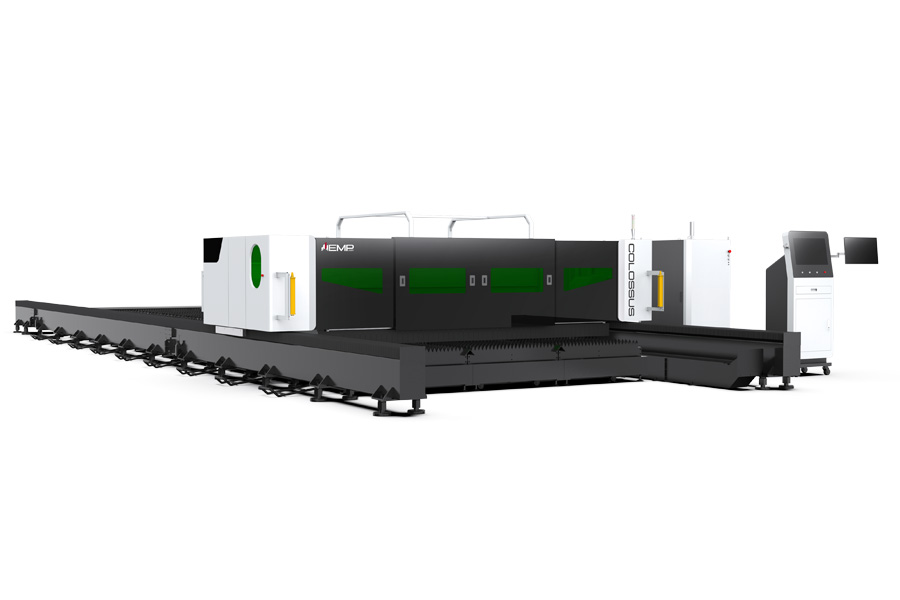
Colossus 25 / 32 / 40 |
Oversized and long plate — skid and equipment bases, long nests, and beveled plate edges | Flat plate — steel, stainless, aluminum | Widths to 13 ft, lengths extending to 72 ft; series configurable from 6 to 200 kW, with the published Colossus 32 (CL32140) configuration at a 10.66 × 47.57 ft working area; optional 45° V/X/Y/K bevel | |
Command 3015 / 4020 / 6020 |
Standard-format plate at production volume — base plates, gussets, reinforcement pads, support plates | Flat sheet and plate | 6020 working area 19.85 × 6.67 ft; 6–40 kW; dual-platform exchange table | |
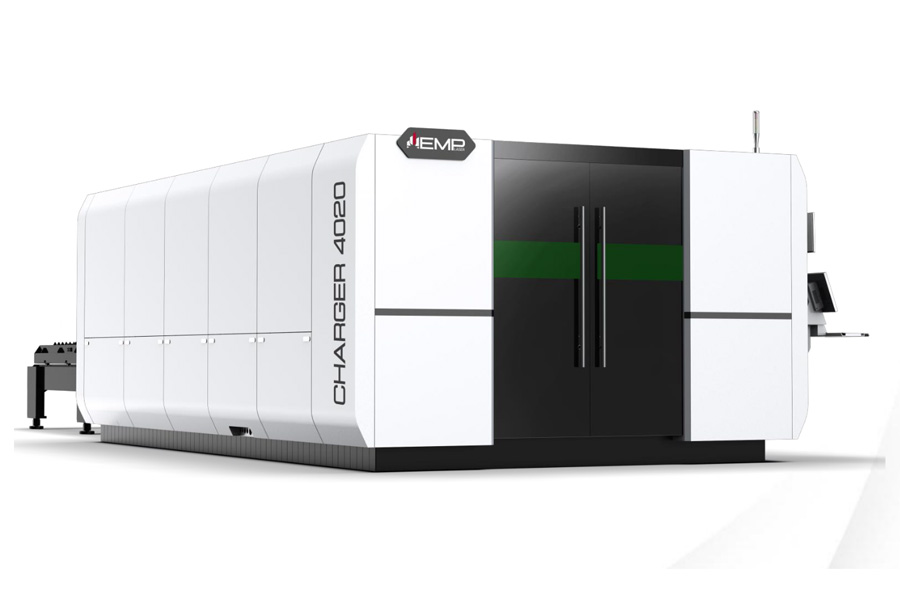
Charger 4020 |
Repeat sheet and plate parts where cycle time governs — brackets, guards, enclosure panels, instrument mounts | Flat sheet and plate | 13.3 × 6.7 ft working area; 6–40 kW; 2.8 G, 131.2 in/sec; dual exchange table | |
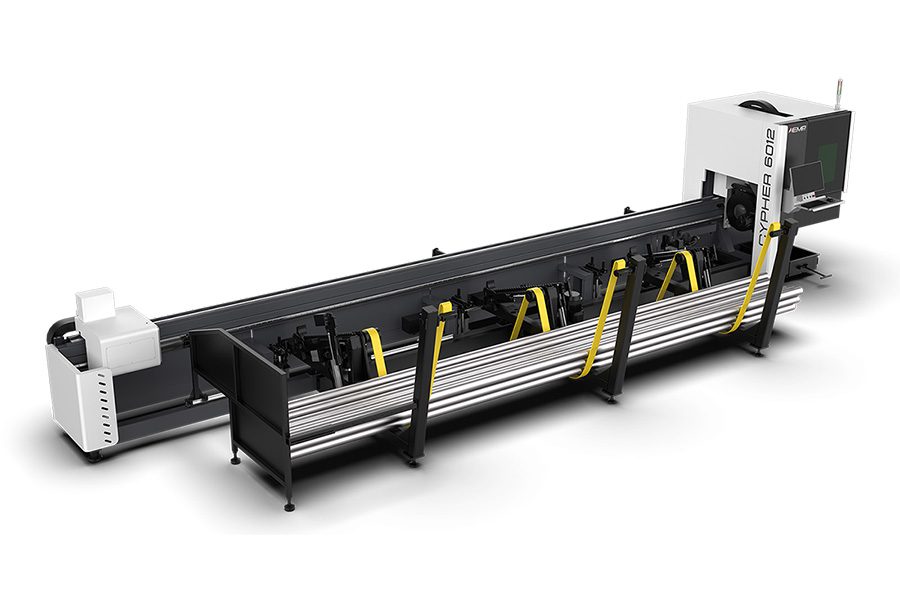
Cypher 6012 |
Small-bore tube and instrument lines | Round tube 0.4–4.72 in. (through NPS 4) | Max tube length 21.32 ft; 1.5–3 kW; 200 rpm; 1.18 in. minimum tailing | |
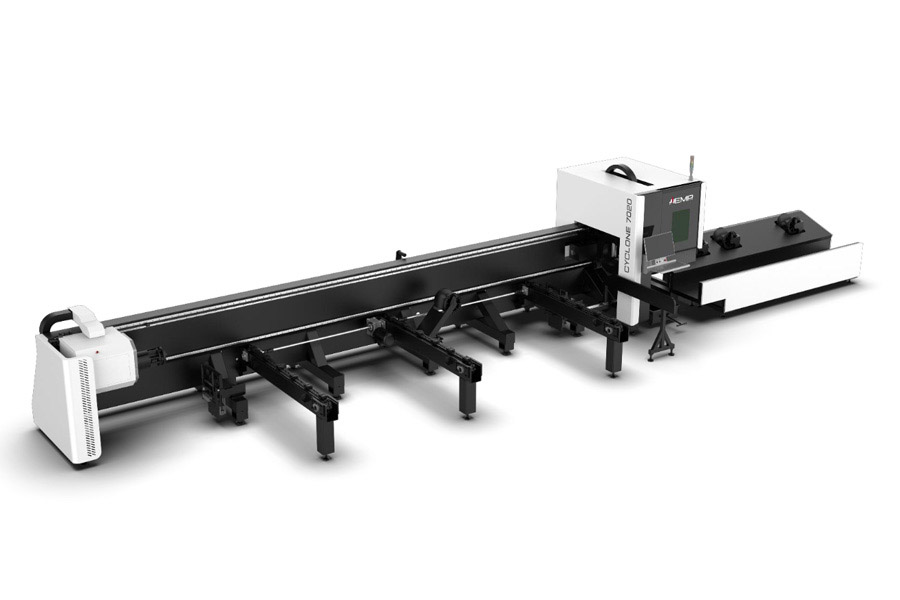
Cyclone 7020 |
Pipe through NPS 8, and HSS for skid frames, racks, and supports | Round 0.6–9 in.; square to 230 mm (9.06 in.); rectangular and other profiles | Max tube length 24.6 ft; 1.5–12 kW; 661 lb max chuck load; automatic centering | |
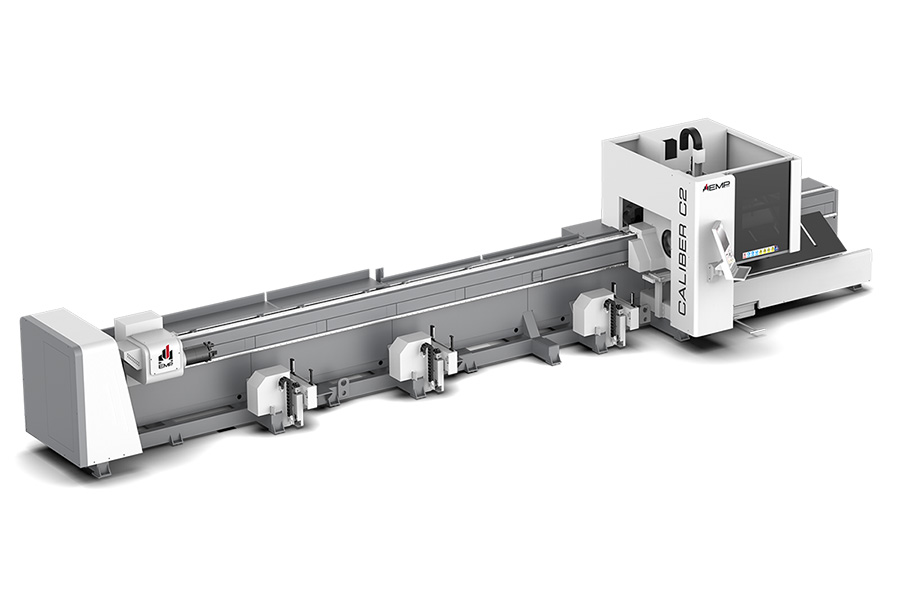
Caliber C2 6026 / 6036 |
Larger pipe stock through NPS 12, heavier structural profile, and beveled weld ends | Round, square, rectangular, angle iron, H steel | Max round diameter 9.8 in. (6026) or 13.78 in. (6036); 6–30 kW; max tube length 21.9–40 ft (6026) or 22.3–40 ft (6036); max load 1,102 or 1,543 lb per piece; optional 45° bevel and flow drilling and tapping | |
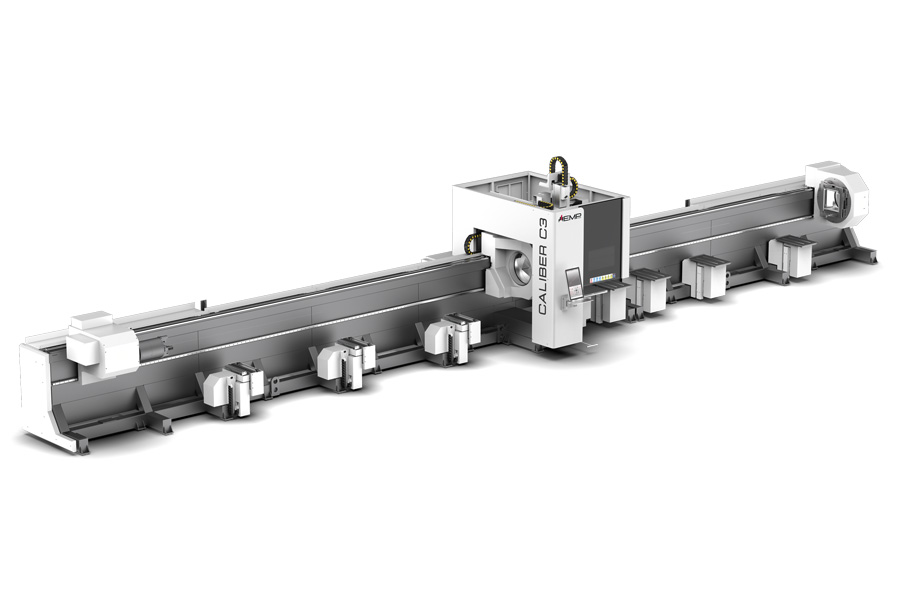
Caliber C3・C4 |
Long structural profile and pipe-rack members at length | Round, square, rectangular, angle iron, H steel | Configurable 20–50 ft maximum tube length; 6–60 kW; the C4's fourth chuck is specified for zero tailing; optional 45° bevel | |
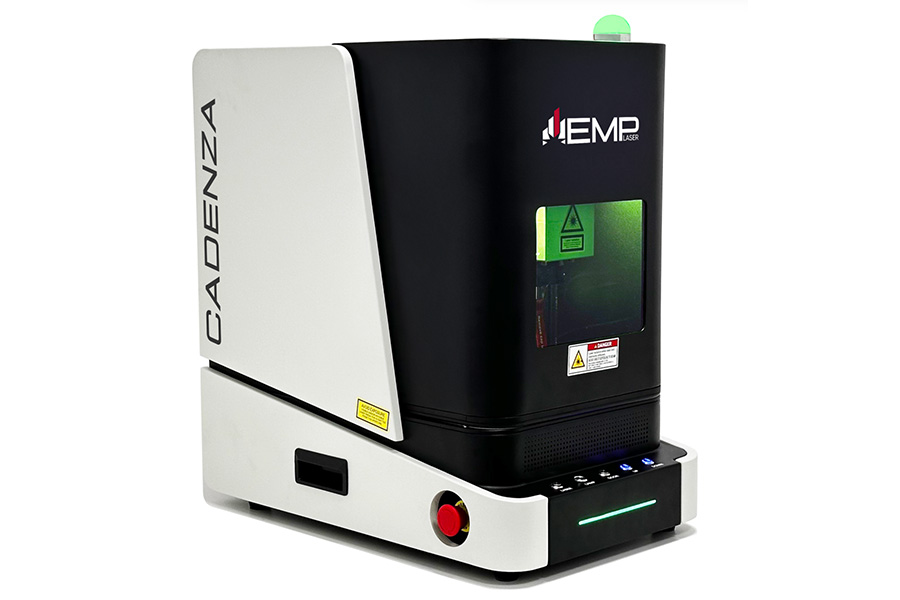
Fiber, MOPA & UV Markers |
Part IDs, serial numbers, barcodes, and QR codes for traceability | Metals; UV marks selected non-metals | Fiber 30 / 50 W; MOPA 60 / 100 W; UV 5 / 10 / 15 W; Cadenza 30 / 60 / 100 / 200 W |
Specifications are published machine figures rather than achievable finished-part tolerances, and they are model- and configuration-specific. Positioning accuracy differs by machine class — ±0.004 in. on the Colossus against ±0.001 in. on the Command 6020 and Charger 4020 — so confirm the figure for the machine you are quoting. Maximum tube length and maximum cut length are different measurements: cut length is stock the machine processes end to end, maximum tube length is stock it accepts. Pipe sizes are mapped by outside diameter per ASME B36.10M; wall thickness and weight per piece also have to fit.
How We Work
From expert planning, delivery and installation to service, training and calibration, EMP Laser provides fast, reliable and professional support.
FAQs
B31.3 accepts a thermally cut weld-end preparation when the surface is reasonably smooth and true and slag has been cleaned from it1. The requirement is written against the surface rather than the cutting process. Whether a change of cutting method touches your qualified welding procedure is a question for your welding engineer.
Yes, fiber lasers can cut pressure vessel components within the machine's envelope and thickness range. Section VIII's cutting provision names machining, shearing, grinding, and oxygen or arc cutting, and laser is not on that list2. For a Section VIII vessel, settle how laser-cut parts are treated with your quality control system and Authorized Inspector before they enter production.
Yes, EMP laser can cut API 5L pipe where the pipe falls within the machine's diameter, wall, length, and weight envelope. API 5L specifies how line pipe is manufactured5. Cutting it into an assembly is fabrication, which answers to the code and specification for what you are building.
Where the material is specified to MR0175/ISO 15156 and any cutting heat-affected zone remains in the finished part, hardness testing is to be specified as part of qualifying the cutting process3. An edge left as cut — a hole, slot, or profiled edge — is the case that needs it. Refinery environments are addressed separately, by MR0103/ISO 1794511.
Yes, laser cutting can produce bevels for pipe and plate welding on machines configured for it. Our Colossus and Caliber tube cutters offer optional 45° bevel in V, X, Y, and K configurations14,16,19, and on the Colossus 32, enabling bevel reduces the usable working envelope. Whether a bevel goes straight to welding depends on your joint detail and qualified procedure.
A a laser-cut edge may need grinding before welding depending on the code and the joint. B31.3 asks for a reasonably smooth, true surface with slag cleaned1, and the WPS sets the joint geometry. Where the governing code and the WPS accept the edge as cut, it goes to welding; where they ask for more, it goes to grinding or machining. For Section VIII work, the cutting provision names the processes it permits, and laser is not among them.
Yes. Duplex stainless can be cut on the same fiber laser equipment as austenitic stainless, with parameters that may need adjusting10, and nitrogen assist gives stainless an unoxidized edge9. For duplex edges that go into service as cut, TWI's guidance is to grind or machine them back by at least 2 mm12; your specification decides whether that applies.
Heat numbers survive laser cutting through a record and a transfer procedure, with the marker as one tool within them. On Section VIII work, markings are transferred to each piece, or a traceable coded marking is applied, before cutting2. Neither CypCut nor Bochu TubePro with TubesT is published as offering MES or heat-lot traceability capability, so ask us what a specific configuration does before building a workflow around it.
They are different tools with different economics. On our own comparison, a high-power fiber system can hold tighter tolerances and produce cleaner edges than plasma across many thick-wall applications18; plasma carries a lower capital cost. There is no single crossover thickness — it depends on your material mix, required edge, and existing equipment. Our fiber laser versus plasma cutting article covers it in detail.
EMP provides installation and calibration, operator and maintenance training, and tailored service and support contracts, starting from a consultation covering workflow, bottlenecks, and production plans. See our services.
Yes, through a third-party lender. See our financing page for current options and terms. We are not the lender; agreements are between the customer and the financing provider.
Ready to Get Started?
Tell us what you fabricate, the materials and sizes you run, and the requirements your parts have to meet. Our team will help you compare configurations built around your production.
Talk to Our Team

Sources
- ASME B31.3-2018, Process Piping: https://ssmalloys.com/wp-content/uploads/2025/03/ASME-B31.3-2018.pdf — Source-class note: a third-party-hosted copy of the 2018 edition, which is not the current edition. Confirm the weld-end preparation wording against the edition your project specifies.
- Welding & NDT, Summary of ASME BPVC Section VIII Div 1 (Part 3): https://www.weldingandndt.com/summary-of-asme-bpvc-section-viii-div-1-part-3/ — Source-class note: secondary summary, not the code text, and the only source for the Section VIII cutting and material-identification wording used here, including the transfer of markings before cutting. The code text was not accessed, and the summary does not state which edition it describes; the 2025 edition of Section VIII is current. Confirm the wording against the edition your work is built to.
- ANSI/NACE MR0175/ISO 15156-2:2020, Petroleum and natural gas industries — Materials for use in H₂S-containing environments in oil and gas production — Part 2: Cracking-resistant carbon and low-alloy steels, and the use of cast irons: https://files.engineering.com/files/f2ab27f0-ab58-4288-a5fa-97cc4db8a4e3/NACE_MR0175_ISO_15156_2_2020.pdf — Source-class note: third-party-hosted copy of the 2020 edition; licensing status not established. The 2020 edition was confirmed as current in September 2026.
- ASME, B31.3 Process Piping standard page: https://www.asme.org/codes-standards/find-codes-standards/b313-2018-process-piping — official summary.
- API Specification 5L, Line Pipe, 46th edition, April 2018, catalog scope summary: https://store.accuristech.com/standards/api-spec-5l?product_id=2010552 — Source-class note: official catalog summary of the scope; the full specification was not accessed. Confirm the edition is current.
- IOGP/JIP33, S-737, Specification for Deluge Skids, October 2021: https://jip33.iogp.org/wp-content/uploads/2021/10/Specification-for-Deluge-Skids-S-737v2021-10.pdf — Source-class note: an international industry specification, cited to show how a skid specification calls on component codes. Not a US requirement.
- API Standard 650, Welded Tanks for Oil Storage: https://standard.do/wp-content/uploads/2020/07/STANDARD-API-STD-650.pdf — Source-class note: third-party-hosted copy whose edition could not be confirmed as current. Confirm the plate-edge preparation wording against the current edition.
- Yamane et al., mill scale in oxygen-assisted laser cutting of thick steel plate, Welding International, 2024: https://www.tandfonline.com/doi/full/10.1080/09507116.2023.2275365 — Source-class note: peer-reviewed, oxygen-assisted plate cutting. Addresses mill scale specifically; does not cover rust, coatings, or pipe.
- EMP Laser, fiber laser cutting process parameters: https://emplaser.com/fiber-laser-cutting-process-parameters — Source-class note: our own technical page. Authoritative for EMP machine and software specifications; for general assist-gas and edge-chemistry guidance it is manufacturer content rather than independent literature.
- International Molybdenum Association, Practical Guidelines for the Fabrication of Duplex Stainless Steels, 3rd edition: https://www.imoa.info/download_files/stainless-steel/Duplex_Stainless_Steel_3rd_Edition.pdf — Source-class note: industry association technical guidance. Its heat-affected-zone discussion is written for plasma-cut edges; the mechanism transfers to laser cutting, specific magnitudes do not.
- ANSI/NACE MR0103-2015/ISO 17945:2015 (R2023), Petroleum, petrochemical and natural gas industries — Metallic materials resistant to sulfide stress cracking in corrosive petroleum refining environments, catalog entry: https://webstore.ansi.org/standards/nace/ansinacemr01032015iso17945 — Source-class note: official catalog entry for the current edition, reaffirmed in 2023; the full text was not accessed. Used for scope only. No requirements are drawn from it.
- TWI, Duplex stainless steel — Part 2, Job Knowledge: https://www.twi-global.com/technical-knowledge/job-knowledge/duplex-stainless-steel-part-2-106 — Source-class note: UK technical guidance, not a US code requirement, and not specific to fiber laser cutting.
- OSHA, 29 CFR 1910.1026, Chromium (VI): https://www.osha.gov/laws-regs/regulations/standardnumber/1910/1910.1026 — full official text.
- EMP Laser, Colossus ground-rail fiber laser plate cutter: https://emplaser.com/emp-colossus-ground-rail-fiber-laser-plate-cutter — our own product page. Bevel travel figures are published under the Colossus 32 (CL32140) table and apply to that configuration. Also the source for the CypCut software description.
- EMP Laser, fiber laser marking machines: https://emplaser.com/fiber-laser-marking-machine — our own product page.
- EMP Laser, Caliber C2 two-chuck fiber laser tube cutter: https://emplaser.com/emp-caliber-two-chuck-fiber-laser-tube-cutter — our own product page. Per-piece load figures are published separately for standard and semi-automatic loading.
- ASME B36.10M, Welded and Seamless Wrought Steel Pipe, dimension table: https://gasplus.ir/wp-content/uploads/2021/06/ASME-B36-10-2004.pdf — Source-class note: third-party-hosted copy of the 2004 edition, which is not the current edition. Used only for outside diameter by nominal pipe size.
- EMP Laser, plasma versus laser tube cutting: https://emplaser.com/plasma-vs-laser-tube-cutting-machine — Source-class note: our own comparison page rather than independent testing, and its claim is qualified — high-power laser systems "can process many thick-wall applications while maintaining tighter tolerances, cleaner edges." That modality is preserved above.
- EMP Laser, Caliber C3/C4 multi-chuck fiber laser tube cutter: https://emplaser.com/emp-caliber-three-chuck-fiber-laser-tube-cutter — our own product page. No diameter or load figure is published for these models.